guide
How AI Learns Music—and What Its Data Misses
Music AI learns numerical patterns from audio, notes, labels, and text. See what each representation teaches—and what narrow training data misses.
AI learns music by turning audio, notes, text, and metadata into numerical patterns and adjusting a model to predict or generate examples like those in its training data. It does not learn music as a person learns a repertoire, scene, instrument, or culture. What the model can recognize or create depends on the recordings, symbolic scores, annotations, descriptions, and rights decisions that shaped its lessons.
Key points
- Audio models learn from waveform or compressed representations; symbolic models learn note and timing events.
- Labels and text connect sound to names such as instrument, genre, mood, or caption, but those names reflect human taxonomies.
- Training objectives teach a model what to predict, not every musical meaning a listener might hear.
- MusicNet offers 1,089,540 aligned note annotations, yet its 330 recordings cover only ten named composers.
- Evaluation on a familiar test set cannot prove that a model works equally well across cultures, eras, production styles, and instruments.
- Licensing, consent, provenance, and creator remedies must be assessed separately from technical performance.
The short answer
A model first needs a representation: numbers that stand in for sound or musical events. It then receives a task, such as predicting a masked audio segment, identifying an instrument, matching sound to a caption, estimating the next note, or removing noise from a latent representation. During training, its parameters change to reduce errors across many examples.
That process can learn powerful regularities. It can detect repeated rhythmic and timbral patterns, transcribe notes, retrieve similar recordings, continue a sequence, or generate audio from a prompt. But it only encounters the forms of music and description present in its data. A model trained mainly on one repertoire can become highly capable within that repertoire while missing much of musical life.
Doldur’s What Music Data Leaves Out audit uses MusicNet to make that trade-off concrete: exceptionally dense note-level information sits beside very narrow composer coverage.
Learning from raw and represented audio
Digital audio is a sequence of sampled amplitude values. Feeding long, high-rate waveforms directly into a model is possible but computationally demanding. Systems may instead use spectrograms, which arrange frequency energy over time, or learned codecs and encoders that compress sound into smaller latent tokens.
The representation changes what is easy to learn. A spectrogram makes frequency patterns visible but does not carry a ready-made concept of melody or groove. A codec can preserve perceptually important sound while discarding detail. A latent encoder may have inherited preferences from its own training data before the music model begins.
Audio examples can teach timbre, production texture, timing, ambience, performance detail, and combinations that written notation omits. They also carry recording conditions: microphones, mastering, compression, noise, room acoustics, and era-specific production. A classifier may use those cues as shortcuts when they correlate with labels.
Learning from MIDI and symbolic notation
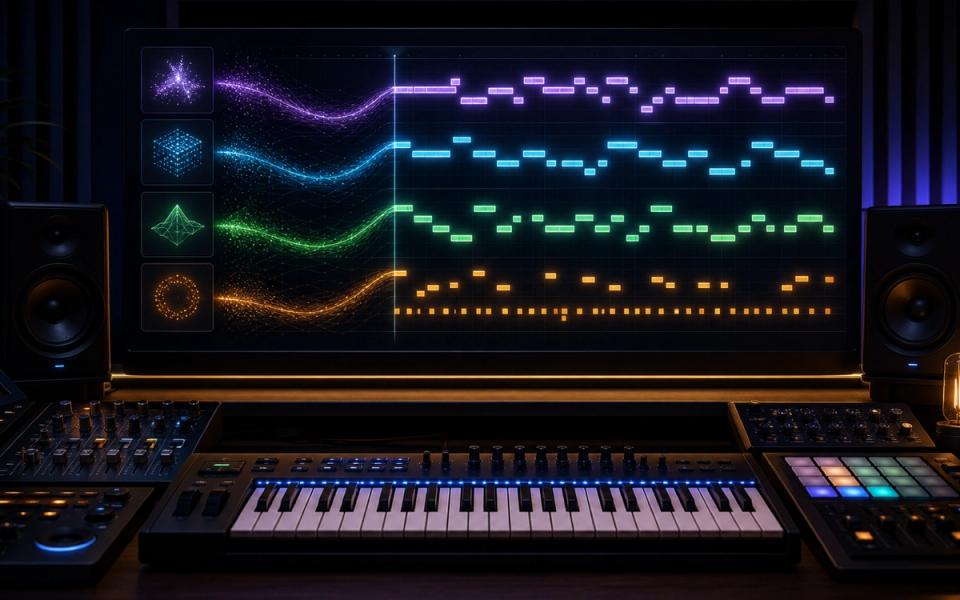
Symbolic representations describe musical events rather than recorded pressure waves. MIDI commonly records note onset, pitch, duration or note-off, velocity, channel, and control messages. Scores can add meter, key, dynamics, articulation, and notation conventions. Models can treat events like a sequence and predict what comes next.
Symbolic data is compact and makes pitch, rhythm, harmony, and structure easier to isolate. It does not automatically capture a performer’s tone, microtiming, tuning system, articulation, room, or production. MIDI was designed around a particular technical system; not every musical tradition fits comfortably into twelve equal-tempered pitch classes and familiar note events.
A score is also an instruction and interpretation, not the music in full. Improvisation, oral transmission, studio construction, non-notated nuance, and collective timing may be absent or simplified. Symbolic learning is one window, not a superior universal form.
Why aligned annotations are valuable
Supervised systems need examples connected to answers. For transcription, that may mean exact note onsets and offsets aligned to audio. For instrument recognition, each segment needs an instrument identity. For structural analysis, annotators mark sections, beats, chords, or motifs.
MusicNet was introduced as a collection of classical recordings paired with more than one million temporal labels. In Doldur’s validated snapshot, 330 recordings contain 1,089,540 annotations across 34.09 hours. Researchers can train and evaluate note-recognition systems with much denser guidance than a simple track-level genre tag provides.
Dense does not mean broad. Ten composers appear. Beethoven accounts for 157 recordings, or 47.6%, and 52.0% of annotations. Solo piano represents 47.3% of recordings. The published MusicNet work also estimated about a 4% label error rate. These boundaries do not invalidate the collection; they identify the work it can support and the generalizations it cannot.
Learning from text and metadata
Text-to-music systems connect audio or musical representations with descriptions. Training pairs may include captions, titles, tags, genres, moods, instruments, or automatically generated text. Contrastive systems learn to place matching text and audio near each other in a shared space. Generative systems learn to produce an audio representation conditioned on words.
The words are not neutral. “Uplifting,” “cinematic,” “Latin,” “dark,” or “female vocal” can be inconsistent, reductive, or culturally loaded. Metadata may describe marketing categories more than sound. Automatically generated captions can multiply errors. Artist and track names can let a model memorize catalogue associations rather than learn the intended musical concept.
MusicGen, for example, is documented as a text-conditioned generative model trained with licensed music data described in its paper and model materials. Its architecture and evaluation explain technical behavior, while its data description defines the repertoire it could encounter. Current model cards should be read alongside—not substituted for—rights and representation audits.
Our article on music genre classification explains why a label can be useful without becoming a universal truth.
What the training objective teaches
Models do not absorb every possible lesson from a recording. An objective directs attention. A transcription system minimizes errors between predicted and annotated notes. A recommendation model may predict a click, completion, save, or next item. A generative model may predict audio tokens or reverse a noise process while following conditioning text.
Optimizing a measurable target can create a capable system and still miss human values. Predicting familiar engagement is not the same as expanding taste. Matching genre labels is not cultural understanding. Generating plausible sound is not giving credit to the people whose work shaped the training examples.
Evaluation metrics inherit the same issue. Accuracy, F-score, retrieval recall, or listener preference studies answer defined questions. They do not prove originality, fairness, safety, legal permission, or equal performance for every repertoire.
What music models commonly miss
Selection gaps come first. Commercial catalogues favor recorded, distributed music. Archives favor what institutions preserved. Open datasets favor works with usable rights and metadata. Platform data favors users and territories present on that service. Oral, local, unpublished, and poorly digitized traditions may barely appear.
Labels create a second gap. Annotations reflect their creators’ vocabulary and available choices. A single genre, mood, or instrument field can erase hybrids and context. Our seven checks for music dataset bias show how to audit selection, time, culture, labels, duplicates, licensing, and missing fields.
Technical representation creates another gap. Standard tuning and notation assumptions can fit some repertoire better than others. Short fixed excerpts may miss long-form development. Stereo masters omit the separate stems needed for source separation. Metadata can omit songwriters, session musicians, cultural origin, or rights holders.
Finally, models miss lived meaning. A recording can carry memory, identity, ritual, protest, language, place, and relationships that are not recoverable from acoustic patterns alone. Larger training runs do not automatically supply absent context.
Generation, recognition, and recommendation learn differently
“Music AI” covers distinct systems. Recognition models map audio to labels or events. Generative models create a continuation or new output. Recommendation models rank existing recordings for a listener. Separation models estimate voices, drums, or instruments from a mix. Their inputs, objectives, errors, and risks differ.
A transcription model trained on MusicNet may be tested on aligned classical notes. A text generator may rely on audio-caption pairs. A recommender learns from catalogues and interaction histories. Good performance in one task says little about another. Even shared encoders should be audited in the actual product context.
This distinction helps artists evaluate claims. Ask what the system learned to predict, which data supported it, and how it was tested. “Trained on millions of songs” is not enough to determine capability or responsibility.
Data rights are not a technical footnote
A dataset can be diverse and still lack appropriate authority. It can be licensed and still concentrate on a narrow commercial catalogue. Responsible development needs both rights and representation questions.
Review provenance at the recording level where practical: source, licence or agreement, permitted purpose, territory, date, attribution, creator choices, and removal process. Distinguish compositions from recordings and account for performers, songwriters, publishers, and labels. Public accessibility is not the same as permission for training.
Our guide to ethical AI music training data provides a fuller review of consent, compensation, transparency, audits, and remedies. The AI music licensing guide helps creators ask what they may release after using a tool.
How to read a model card
Start with the task and representation. Find the exact training sources, dates, licences, languages, regions, genres, recording types, and exclusions. If only scale is disclosed, the description is incomplete.
Then inspect evaluation. Were artists or recordings separated between train and test sets? Were external cultural and production contexts included? Who took part in listening studies? Are failure examples published? Does the model card distinguish known limitations from untested areas?
Finally, look for governance: opt-out or withdrawal mechanisms, attribution, safety controls, privacy handling, complaint routes, version history, and changes between releases. Documentation cannot guarantee good conduct, but absent documentation prevents meaningful scrutiny.
Conclusion
AI learns music by optimizing predictions over representations chosen by people. Audio can preserve performance detail, symbolic events clarify notes and structure, and text supplies concepts, but each loses or reshapes something. MusicNet shows the bargain vividly: over one million aligned note labels within only 330 recordings and ten composers.
The useful question is not whether a model “understands music” in the abstract. Ask what it was trained to do, what repertoire and annotations made that possible, what it misses, and who had authority over the examples. Continue with Doldur’s music-data boundary audit before trusting a broad model claim.
Frequently asked questions
Does music AI listen like a person?
No. It processes numerical representations and learns an objective from examples. People bring bodies, histories, attention, relationships, and cultural knowledge that the training procedure does not reproduce.
Is MIDI enough to train a music model?
It can be excellent for note sequences and structure, but it leaves out much recorded sound and does not represent every musical system equally well.
Does more training data remove bias?
Not automatically. More examples can scale the same catalogue, language, rights, and taxonomy gaps. Coverage and provenance matter alongside size.
Sources
- Doldur Music, What Music Data Leaves Out.
- Thickstun et al., Learning Features of Music from Scratch.
- Copet et al., Simple and Controllable Music Generation.
- Weerawardhana et al., Sound Check.
Sources and further reading
- Doldur Music: What Music Data Leaves OutOwned MusicNet validation and coverage findings.
- Learning Features of Music from ScratchOriginal MusicNet paper and temporal-label design.
- Simple and Controllable Music GenerationMusicGen architecture, conditioning, training and evaluation context.
- Sound CheckAudio-dataset documentation and cultural audit framework.