guide
How Spotify AI Credits Work—and What They Don’t Prove
Learn where Spotify AI credits appear, which creative roles they describe, why missing credits prove nothing, and how artists can preserve accurate records.
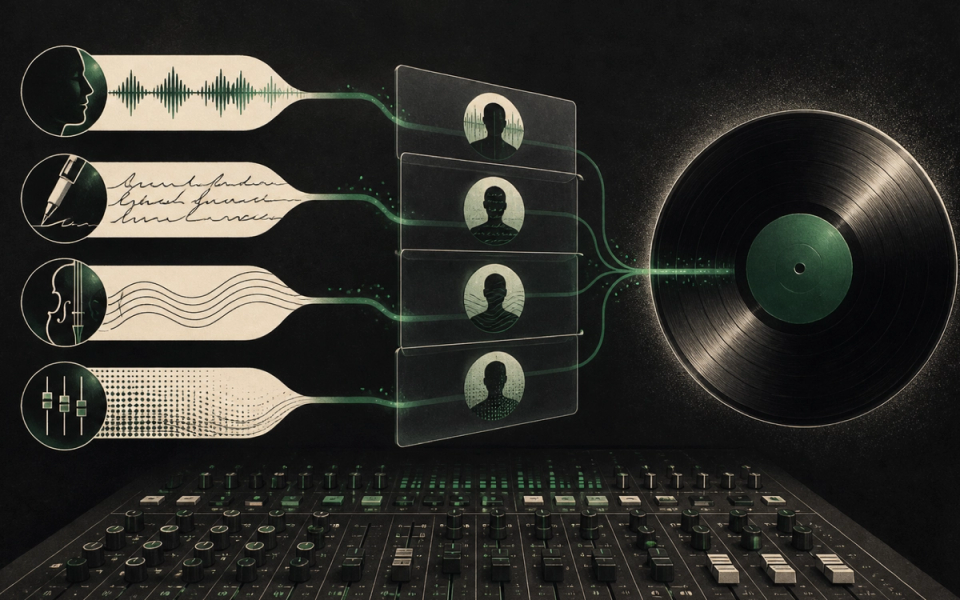
Spotify AI credits show whether an artist or rights holder has disclosed AI use in a specific role such as lyrics, vocals, instrumentals, or production. They do not label the whole track as AI-generated, they do not appear as a badge beside every song, and their absence does not prove that no AI was used. As of August 2026, Spotify describes the feature as a mobile-app beta available through participating distributors.
That makes AI credits useful but narrow. Read them as structured creative information, not as a detector result, legal clearance, quality score, or universal definition of an AI song.
Key points
- Spotify AI credits describe a disclosed contribution to a song, not an all-or-nothing classification.
- The current beta can identify AI involvement in lyrics, vocals, instrumentals, or production.
- Credits are optional and initially depend on participating labels or distributors.
- Missing credits are missing disclosure, not evidence of a human-only workflow.
- AI credits are separate from Verified by Spotify, platform policy enforcement, copyright, and artist-profile mapping.
- Artists should preserve accurate production records even when their distributor does not yet expose the field.
What are Spotify AI credits?
Spotify AI credits are structured song-credit fields that tell listeners how artificial intelligence contributed to a recording when the artist, label, or distributor supplies that information. The feature aims to represent AI use as a spectrum. A release may use generation for one vocal, instrumental passage, lyric draft, or production process without turning every part of the song into machine-generated content.
Spotify announced support for an industry-standard disclosure approach developed through DDEX and began showing submitted information in its mobile song credits during a 2026 beta. The platform’s current listener documentation lists four visible contribution areas: lyrics, vocals, instrumentals, and production.
This is closer to a production credit than a warning label. It answers “where did AI contribute?” when the metadata exists. It does not answer every question about authorship, consent, ownership, training data, or artistic value.
How to find AI credits on Spotify
Spotify currently documents two mobile paths:
- Open the song’s menu and select View song credits.
- In the Now Playing view, scroll to the Credits section.
If the release carries a supported disclosure, the relevant AI role can appear there. Spotify says the credits do not currently appear on artist profiles or as track-level labels beside the title. The interface, territories, distributors, and availability may change while the feature is in beta, so check the live support page when exact instructions matter.
Do not interpret a missing field too quickly. The artist may not have opted in, the distributor may not support the field, the metadata may not have reached Spotify, or the contribution may predate the current workflow.
What each AI-credit role can mean
The role names are broad enough to cover several production methods. A useful reader should ask what the credited party or release notes say beyond the label.
Lyrics
An AI lyrics credit can indicate that a system generated, continued, transformed, translated, or otherwise assisted words. It does not reveal whether the human kept one phrase or an entire draft, who made the final selections, or whether the resulting lyrics qualify for copyright protection in a particular country.
Normal songwriter credits still need to identify actual human or organizational contributors accurately. A model should not be invented as a person, and a human should not take credit for work they did not contribute.
Vocals
An AI vocals credit may cover a generated singer, voice conversion, transformation, repair, or another AI-assisted vocal process. The credit alone does not prove that a named performer consented to a replica or that the output avoids similarity to another artist.
Voice authorization remains a separate question. Spotify’s current artist protections address unauthorized vocal impersonation through their own reporting and enforcement process.
Instrumentals
An instrumental credit can describe generated accompaniment, isolated parts, textures, stems, or other non-vocal material. It does not say whether the rest of the composition was written by a human, whether a musician later replayed the part, or whether all source inputs were licensed.
Production
Production is the widest role. It can include AI-assisted arrangement, sound design, editing, separation, restoration, mixing, mastering, or another technical contribution. A production credit should not be read as evidence that the composition, lyrics, or performances were generated.
What Spotify AI credits do not prove
AI credits provide context. They are not a complete audit.
AI credit can show
AI credit cannot prove
A disclosed AI role on a specific song
That the entire track is AI-generated
Information delivered through a participating supply chain
That every AI use has been disclosed
A distinction between lyrics, vocals, instrumentals, and production
The percentage of human and generated work
The release’s submitted metadata
Copyright ownership or legal noninfringement
A form of transparency
Audio quality, originality, consent, or artistic merit
The same limit applies in reverse. A release without AI credits is not certified human. Spotify explicitly states that absence of the field does not mean AI was not used.
AI credits are not an AI detector
A detector analyzes an audio file and estimates whether it contains learned patterns associated with generation. Spotify AI credits are supplied metadata. One is an inference; the other is a disclosure.
Both can be incomplete. A detector can produce false positives, miss a new model, or struggle with hybrid human-AI production. A metadata field can be absent, inaccurate, delayed, or unsupported by the distributor. Neither should be used alone to accuse an artist of deception.
For a broader investigation, combine credits with identity history, collaborators, real-world activity, and careful technical evidence. Doldur Music’s guide to AI-generated music detection explains the technical limits.
AI credits are separate from Verified by Spotify
Verified by Spotify is an artist-identity signal. Spotify says the verification process combines standards with human review and is intended to help listeners trust who is behind the music. At launch, profiles that primarily represent AI-generated or AI-persona artists are not eligible for that badge.
An AI credit answers a different question. A verified human artist can use AI in a disclosed production role. An AI artist identity can be transparent without receiving human-artist verification. An unverified profile may simply be new or not yet reviewed.
Do not use one feature as a shortcut for the other:
- AI credits: how AI contributed to a song, when disclosed.
- Verified by Spotify: current platform review of an artist identity.
- Profile mapping: whether a release reached the correct artist page.
- Policy enforcement: whether content or behavior violates platform rules.
AI credits are not legal clearance
A disclosed AI role does not establish that the inputs were licensed, a voice was authorized, samples were cleared, contributors agreed to the release, or the final work is protected by copyright. Those questions depend on facts, contracts, platform terms, and applicable law.
Similarly, a track remaining available on Spotify is not a legal opinion. Platforms and distributors process large catalogues through metadata, claims, automated systems, and contractual warranties. Availability can change after a complaint or correction.
The Doldur Music guide to Spotify’s AI music policies separates identity, voice impersonation, spam, artificial streaming, rights, and metadata. Use that wider checklist before treating one credit field as release approval.
How artists should prepare AI credits
Artists should keep a private production record before the distributor asks for metadata. The record can be short, but it should be specific enough to support a future disclosure or dispute.
For each track, save:
- the tool, product version, model, plan, and date;
- the input type, including prompts, audio, MIDI, lyrics, or reference material;
- which outputs were used and which were rejected;
- the human edits, performances, arrangement, and production decisions;
- voice, collaborator, sample, master, composition, and artwork permissions;
- the distributor questionnaire and submitted credits;
- the terms that applied when the material was created;
- the final project, stems, master, and release metadata.
This is not an invitation to publish private prompts or confidential files. It is an internal provenance record that lets the artist answer accurate questions later.
What to do when the distributor does not support AI credits
Do not invent unsupported metadata fields or clutter the artist name and song title with unofficial labels. Answer every distributor question truthfully, keep normal contributor roles accurate, and preserve the internal record.
Where appropriate, an artist can explain the process on an official release page, project note, or editorial disclosure. The statement should name the contribution in plain language: “AI-assisted vocal transformation,” “generated instrumental draft rebuilt by the producer,” or “AI-assisted mix analysis.” Avoid vague claims such as “made with technology” when the role can be stated clearly.
When the distributor adds the supported field, update the delivery through its normal metadata process. Check the live Spotify credits after the change reaches the service.
How Doldur Music approaches AI disclosure
Doldur Music presents its represented acts as AI artist identities under human creative direction. The public artist pages identify that relationship instead of asking listeners to infer it from a sound or image. Editorial material can also carry an AI-assistance note when generative systems materially supported research or drafting.
That first-party approach shapes this guidance: disclosure should name responsibility, not erase it. “AI was used” is more useful when readers can also see who directed, selected, edited, performed, checked, and published the work.
Frequently asked questions
Are Spotify AI credits mandatory?
Spotify currently describes them as optional and initially available through certain distributors. Recheck the official support page because beta participation can expand.
Do Spotify AI credits affect recommendations or royalties?
Spotify’s disclosure announcement says the purpose is transparency, not punishing responsible AI use or automatically reducing ranking. The credit itself should not be confused with spam, fraud, or artificial-streaming enforcement.
Can listeners see AI credits on desktop?
Spotify currently documents the beta in the mobile app. Desktop and regional availability may change, so verify the live interface and support page.
Does a vocal AI credit mean an artist cloned someone’s voice?
No. It identifies an AI-related vocal contribution, not whether it was authorized or whose voice was involved. Consent and impersonation require separate evidence.
Should an AI model be listed as a songwriter?
Do not invent a model as a human contributor. Follow the distributor’s supported AI fields and enter human songwriter, performer, producer, and engineer roles accurately.
Read the role, then ask what remains unknown
Spotify AI credits are a useful step toward more precise music metadata. They can distinguish AI lyrics, vocals, instrumentals, and production without pretending every track is simply “AI” or “not AI.” Their value depends on accurate participation and careful reading. Use the credit as one verified fact, then keep identity, consent, rights, detection, and quality as separate questions.
Sources and further reading
- Spotify AI CreditsCurrent beta roles, mobile viewing paths, optional participation, profile visibility, and missing-credit limitation.
- Spotify AI Protections for Artists and ProducersIndustry-standard DDEX disclosure direction, role-based AI use, transparency purpose, and rollout context.
- Verified by SpotifySeparate artist-identity verification signal, current eligibility, and rollout limitations.
- Spotify for Artists: AI CreditsArtist-facing submission context, participating distributor dependency, and visible roles.