analysis
How AI-Generated Music Detection Works
AI-music detectors classify learned audio patterns. Their scores depend on the target, dataset, model coverage, processing, and threshold and require corroboration.
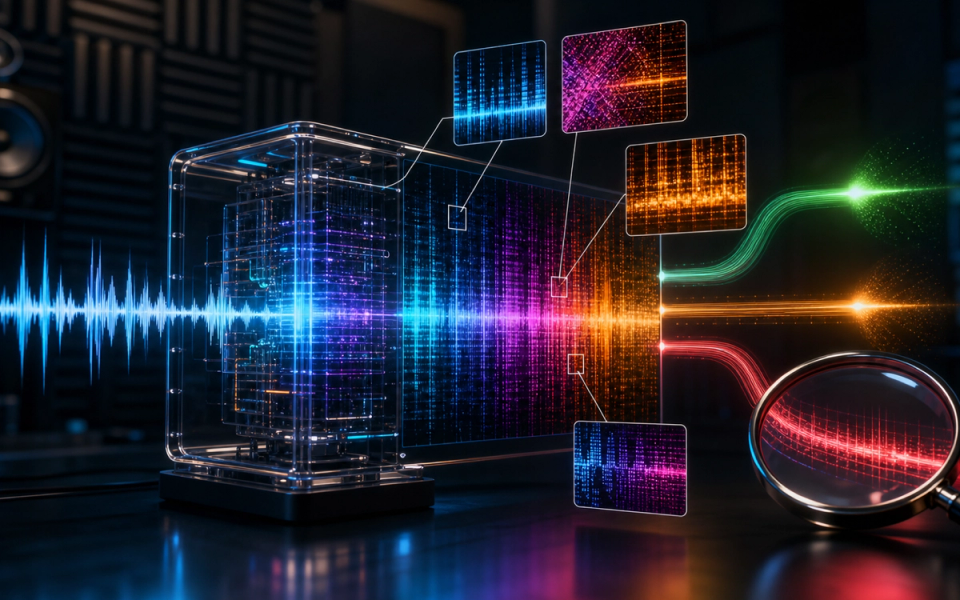
AI-music detectors do not listen for a magical “synthetic” frequency. They estimate whether patterns in audio resemble examples produced by known generators. A typical system converts a track into time-frequency features, extracts learned representations, and produces a score. Some services combine that score with metadata, provenance, catalog behavior, identity signals, and fraud detection.
A high score is evidence for review, not proof of authorship, infringement, fraud, or lack of human work. Detectors can fail on new models, hybrid productions, mastering, compression, stems, covers, short clips, unusual human recordings, and deliberate evasion. A robust decision uses several signals plus a documented appeal process.
What the system is trying to classify
“AI-generated music” is not one technical class. A track may be:
- Fully rendered by a text-to-music model.
- Human-written with a synthetic singer.
- Human-performed with generated accompaniment.
- Generated as MIDI and rendered with conventional instruments.
- Built from generated stems and extensive human editing.
- Human-made but cleaned, mixed, or mastered with AI.
- A conventional recording that happens to resemble model artifacts.
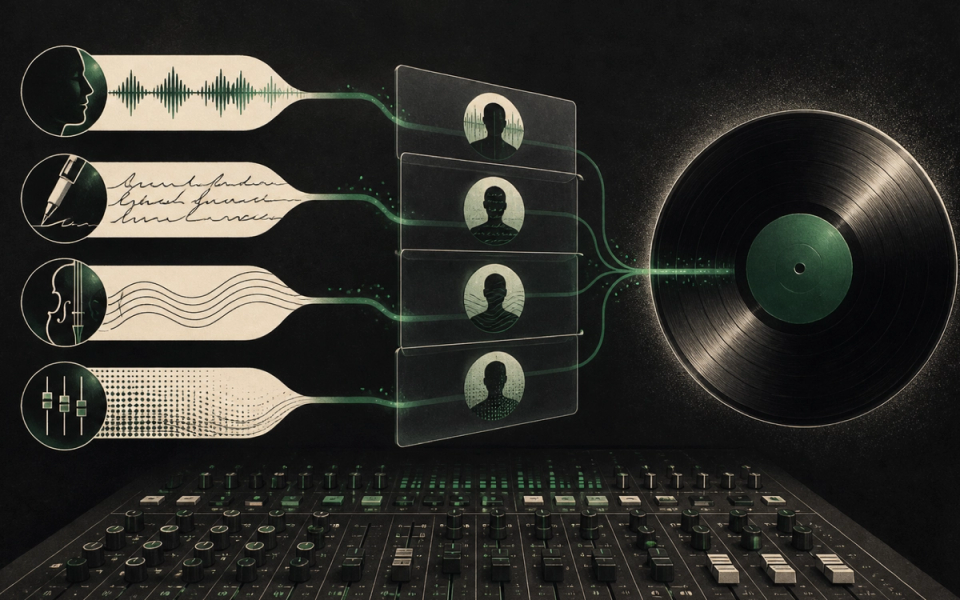
Binary labels compress these cases. Before evaluating a detector, define its target: fully synthetic songs from specific models, cloned singing voices, generated instrumental audio, or any AI assistance. A model trained for one target should not be assumed to solve the others.
The detection pipeline
1. Audio preparation
The system standardizes sample rate, channel count, loudness, and clip length. It may analyze the full song or select windows. Vocal and instrumental segments can be separated because a synthetic singer and synthetic accompaniment leave different evidence.
Preparation affects results. A model trained on pristine WAV files can behave differently on low-bitrate streaming audio. A detector using only 10 seconds may miss a generated section elsewhere or overreact to an unusual intro.
2. Time-frequency representation
Audio waveforms are often converted into spectrograms or mel-spectrograms. These images represent how energy changes across frequency and time. Neural networks can learn recurring textures, transients, modulation patterns, spectral gaps, phase relationships, and high-frequency behavior that correlate with training examples.
Other systems learn directly from waveform samples or use representations from large pretrained audio models. No representation contains a legal answer; it supplies measurable features.
3. Feature extraction
The detector learns combinations that distinguish its real and generated training sets. Potential cues include overly smooth or unstable harmonics, smeared transients, inconsistent room acoustics, repeated microtextures, vocal formant behavior, phase artifacts, or correlations introduced by a generator’s decoder.
These should be treated as learned statistical cues, not a checklist a listener can apply reliably. A human mix can contain heavy denoising, time stretching, spectral repair, chorus, saturation, or lossy artifacts. A generator can improve or change architecture. Individual cues are not exclusive to either class.
4. Classification and score
A classifier maps the representation to a probability-like score or label. The operating threshold determines the tradeoff between false positives and false negatives.
A service that screens millions of uploads may choose a conservative threshold and send ambiguous tracks to another stage. A research benchmark may report accuracy at a balanced threshold that does not match real catalog prevalence. Scores from two tools are not directly comparable unless their datasets, targets, and calibration are known.
5. Model-specific and general detectors
Model-specific detectors learn fingerprints from examples generated by a known system. They can perform strongly when future files resemble those examples, but may miss a new model or version.
General detectors try to identify broader synthetic patterns or out-of-distribution behavior. They may transfer better to unseen generators but face a harder task and more varied false positives.
Deezer says its production technology can detect fully generated music from prolific models such as Suno and Udio and can add other tools when relevant examples are available. The company also says it is working on generalization beyond specific training datasets. Those are provider-reported production claims, not a guarantee for every hybrid, edited, or future track.
Why benchmark accuracy can mislead
Deezer reported 99.8% accuracy for its detector in June 2026. That is meaningful within the provider’s evaluation, but a percentage needs context:
- What counts as AI-generated?
- Which model versions were included?
- Were songs fully synthetic or hybrid?
- What genres, languages, eras, and recording conditions were represented?
- Were training and test sources independent?
- Did evaluation include MP3 compression, mastering, stems, edits, and short clips?
- What were the false-positive and false-negative rates at the chosen threshold?
- How common is the target class in the actual catalog being screened?
Even a low false-positive rate can produce many reviews at platform scale. Accuracy alone also hides class imbalance. Precision, recall, calibration, subgroup performance, and performance on unseen generators matter.
Research reinforces the caution. Studies on AI-generated music detection show that classifiers can score very highly on curated datasets while warning about generalization. Work evaluating audio augmentations finds performance can change after processing. Broader audio-deepfake benchmarks similarly emphasize that results depend on models, datasets, and conditions.
Common failure modes
New generators
Detection is an arms race. A classifier trained on yesterday’s generator may not recognize a new architecture, decoder, or post-processing chain. Continuous dataset updates are necessary.
Hybrid production
A human vocal over generated instruments, an AI vocal over human playing, or one generated transition inside a human track challenges a whole-song label. Window-level results and contribution metadata are more informative.
Mastering and distribution
Equalization, limiting, stereo widening, noise reduction, resampling, and codec compression alter the cues a detector uses. Research evaluation should include realistic delivery transformations.
Unusual human recordings
Lo-fi devices, aggressive Auto-Tune, synthetic instruments, granular processing, rigid quantization, sample packs, speech synthesis used as an effect, or archival noise can look unlike a detector’s human training set.
Short or quiet material
A few seconds of ambience or a sparse intro may not provide enough evidence. Scores should expose uncertainty rather than force a confident label.
Adversarial editing
Someone can attempt to mask fingerprints with noise, re-encoding, filtering, pitch changes, or additional layers. Defenses should assume evasion without treating ordinary mastering as suspicious.
Audio detection is not fraud detection
A generated track can receive authentic listening. A human track can use bots. Platforms therefore examine behavioral signals separately: account networks, stream timing, device patterns, playlist activity, upload volume, duplicate audio, metadata manipulation, and payment behavior.
Spotify’s published approach illustrates this separation. It targets unauthorized voice impersonation, mass-upload spam, deceptive profile delivery, and artificial streaming rather than announcing a universal synthetic-audio label. Deezer, by contrast, publicly tags fully generated music and says it excludes such tracks from algorithmic and editorial recommendations while separately demonetizing streams it classifies as fraudulent.
Do not infer fraud from an audio score. Fraud requires evidence about conduct.
Detection is not copyright analysis
A detector cannot determine whether training data was licensed, whether a voice was authorized, whether output is substantially similar to a protected work, or whether human contributions qualify for copyright. It also cannot know the governing contracts.
Likewise, a “human” result does not clear samples or ownership, and an “AI” result does not prove infringement. Use copyright records, licenses, generation logs, project files, agreements, and expert analysis for those questions.
Our AI music licensing overview covers the rights framework. Doldur Music’s AI music trends article tracks the broader market shift.
Provenance and metadata
Detection estimates from the finished signal. Provenance records how the work was made. The two are complementary.
A useful provenance package includes:
- Tool, model, version, account plan, and generation date.
- Prompts, seeds, source inputs, and output IDs.
- DAW sessions and version history.
- Human performances, lyrics, MIDI, and arrangement edits.
- Voice and collaborator permissions.
- Sample, loop, and model licenses.
- Distributor delivery and AI-disclosure fields.
- Cryptographic content credentials where the workflow supports them.
Provenance can be missing or falsified, so detection still matters. Detection can be wrong, so provenance and appeals still matter.
How to evaluate a detector
Ask the provider:
- What exact class does the score represent?
- Which generators and versions were evaluated?
- Does the model detect full songs, voices, instruments, or any AI use?
- How does it perform on unseen models and hybrid tracks?
- Are results robust to MP3, mastering, stems, and short clips?
- What are precision, recall, false-positive rate, and calibration?
- Is performance reported by genre, language, era, and production style?
- How often is the detector updated?
- Is uploaded audio stored or used for training?
- Can artists challenge a result and submit provenance?
A tool that returns only a confident percentage without defining its target or limitations should not control a high-stakes decision alone.
A responsible platform workflow
Stage 1: metadata and catalog checks
Validate artist identity, identifiers, duplicate assets, upload velocity, rights fields, and delivery relationships.
Stage 2: audio screening
Run several windows and, where useful, vocal and accompaniment analysis. Preserve model version and score details.
Stage 3: confidence bands
Use clear bands such as low evidence, uncertain, and high evidence. Avoid turning a marginal score into a public accusation.
Stage 4: corroboration
Compare provenance, distributor declarations, known generator fingerprints, behavioral signals, and rightsholder claims.
Stage 5: proportionate action
Labeling, recommendation treatment, monetization review, identity protection, and fraud enforcement solve different problems. Choose the action tied to the evidence.
Stage 6: appeal and monitoring
Give creators the reason category, accept project evidence, audit errors, and re-evaluate when detectors change. Track false positives across genre and community.
What artists should do
- Keep generation and project records even when no platform asks today.
- Use accurate contributor and AI metadata where available.
- Do not use a consumer detector result as a clearance certificate.
- Test a detector only with files you are allowed to upload.
- Preserve pre-master and final versions if a score changes after processing.
- Respond to a flag with provenance, licenses, sessions, and specific corrections.
- Avoid claims that a low score proves a track is human or a high score proves fraud.
Our existing Spotify AI-music coverage provides platform context for these detection decisions.
Final takeaway
AI-music detection works by learning statistical differences in audio examples and applying them to new files. It can be useful at scale, especially for known fully generative models, but its reliability is bounded by definitions, datasets, model drift, editing, and real-world diversity.
The defensible system does not ask one classifier to decide everything. It combines audio evidence, provenance, metadata, identity, rights records, behavior, human review, and appeal. Detection should create a better question—not an automatic verdict.
Sources and further reading
- Deezer AI Music Detector LaunchCurrent detector scope, provider-reported accuracy, user tool, labeling history, and listener research.
- Deezer Detection Technology UpdateCurrent model-specific and generalization claims plus separation of AI detection from fraud demonetization.
- AI-Generated Music Detection and its ChallengesDetection pipeline, high benchmark results, artifacts, generalization limits, and cautions about commercial checkers.
- Detecting Musical DeepfakesMusic-specific classification research using human and generated song datasets.
- Evaluating Fake Music Detection Under Audio AugmentationsEvaluation of how realistic audio transformations affect fake-music detection.
- FakeMusicCaps Benchmark, ICLR 2025Benchmark distinctions between fully generated songs and partially synthetic musical components.