guide
Infinite Album Status: What Happened to the AI Game Music App?
Infinite Album is no longer available in its original form. This update explains what it offered, what changed, and current options for stream-safe adaptive music.
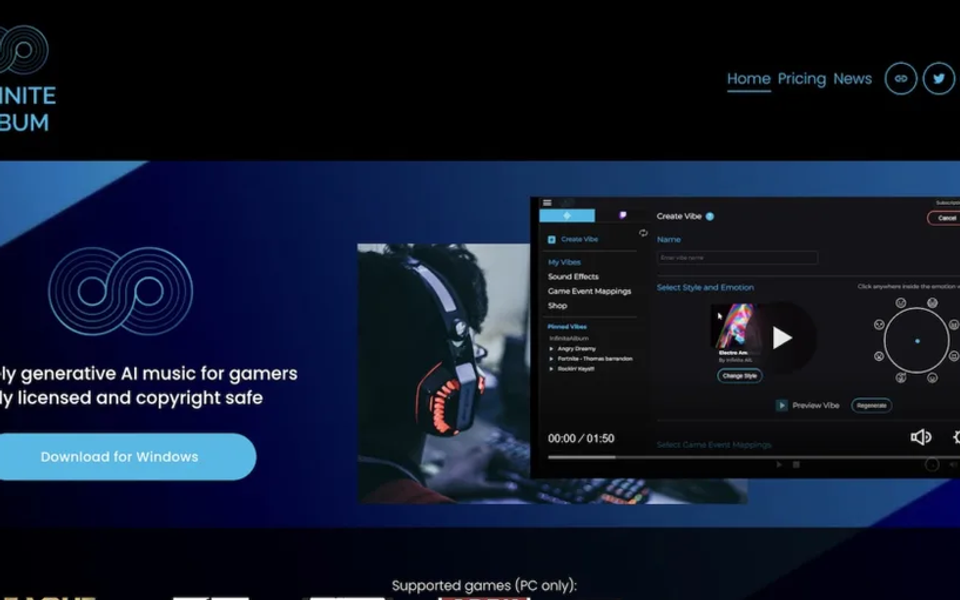
Infinite Album is no longer available in the form reviewed on this page in 2024. The company’s official site now says the original product has ended and that its team and technology are moving into a new chapter. This page is retained because the product’s real-time generative music model remains an instructive example for games and livestreams, but old download, pricing, and plan details should be treated as historical.
What Infinite Album offered
Infinite Album generated music continuously and reacted to gameplay events. Streamers could shape musical style and emotion, connect the experience to games, and in some versions let Twitch viewers influence the soundtrack. The company says it worked with real artists and offered creators a copyright-safe route to music for streams.
The central idea was stronger than a conventional playlist: music could respond to what happened on screen instead of playing as a fixed recording. That model sits between adaptive game scoring, generative composition, and audience interaction.
What changed
The current homepage states that “Infinite Album as you know it and as you’ve used it is no longer available.” It says the underlying ideas, technology, and team are continuing in a different direction, with future information still to be announced. No current pricing or product-access claim should therefore be inferred from the 2024 review.
For existing users, the practical action is to export any available assets, keep records of licenses that applied to past streams, remove broken setup links, and avoid promising future access to viewers or clients.
Why the concept still matters
Adaptive music solves a real problem. A streamer needs long-form sound that does not become repetitive, a game needs music that follows intensity without abrupt cuts, and an interactive show may want the audience to affect mood. Generative systems can vary musical material while a rules layer keeps transitions within the desired style.
The hard part is not endless playback. It is musical continuity, predictable latency, controllable intensity, rights clarity, and graceful failure when the game integration stops. Any replacement should be judged against those operational requirements.
How to choose a replacement
- Decide whether you need adaptive game scoring, stream-safe background music, viewer interaction, or all three.
- Check whether the license covers live streams, archived VODs, clips, sponsorships, and monetized channels.
- Confirm how the service handles copyright claims and whether it provides claim-release documentation.
- Test latency and transitions during real gameplay, including scene changes and connection loss.
- Keep a fallback playlist or local music bed if the generator becomes unavailable.
- Archive receipts, plan terms, track logs, and support messages for every monetized production.
Alternatives by use case
- For ordinary livestreams, use a reputable stream-safe catalog with a license that covers VODs and clips.
- For games, use middleware and composed stems when precise interactive scoring matters more than infinite variation.
- For experimental installations, combine a generative engine with a human-designed rules system and local fallback.
- For audience interaction, connect approved music states to channel points or control inputs without granting unrestricted generation.
Rights and “copyright-safe” claims
A platform can license its output for a defined use, but that does not make every downstream use risk-free. Streamers should read whether the license covers commercial channels, brand work, exports, reuploads, and music-only redistribution. Keep the terms that were in effect when content was created.
If a service disappears, old VODs may remain online. Saved documentation is the evidence needed if a later automated claim appears.
Verdict
Infinite Album should now be treated as a discontinued product and an important case study, not a current recommendation. Its legacy is the idea that game and livestream music can be reactive, participatory, and artist-connected. Anyone replacing it should prioritize continuity, rights documentation, exportability, and a fallback path as highly as the quality of the generated music.
Frequently asked questions
Is Infinite Album still available? The company says the original product is no longer available.
Can I still use old Infinite Album streams? Existing content depends on the license that applied when it was created; keep those records.
What should I use instead? Choose based on the real job: adaptive game scoring, stream-safe catalog music, or viewer-controlled interaction.
Sources and further reading
- Infinite Album — Official status noticeCurrent notice that the original product is no longer available.
- Twitch — Music GuidelinesPlatform rules for music in streams and VODs.
- U.S. Copyright Office — Music and copyright resourcesRights background for music uses.