guide
AI Mixing vs Human Mixing: Where Each Works
AI mixing is fast at measurement, repeatable starting points, and narrow corrections; human engineers remain stronger at context, taste, communication, and exceptions.
AI mixing and human mixing are not interchangeable services. AI systems are strongest at fast analysis, repeatable starting points, constrained processing, and technical checks. Human mix engineers are strongest at interpreting artistic intent, hearing context across an entire song or catalog, communicating through ambiguous feedback, and making exceptions that deliberately break a norm.
For many independent artists, the best answer is a hybrid workflow: use automation for organization, first-pass balance, masking checks, and alternate masters; use a person for priorities, revision decisions, translation, quality control, and the final release judgment.
Key points
- AI is useful when the task can be measured, repeated, and described with clear inputs.
- A human is valuable when the goal is emotional, contextual, collaborative, or exceptional.
- “Human” does not automatically mean good, and “AI” does not automatically mean generic.
- Compare outputs at matched loudness and over the entire song.
- The recording, editing, and arrangement set the ceiling for both approaches.
- Cloud automation requires privacy and retention checks for unreleased material.
- Use budget and release risk to decide where human attention has the highest value.
What AI mixing actually does
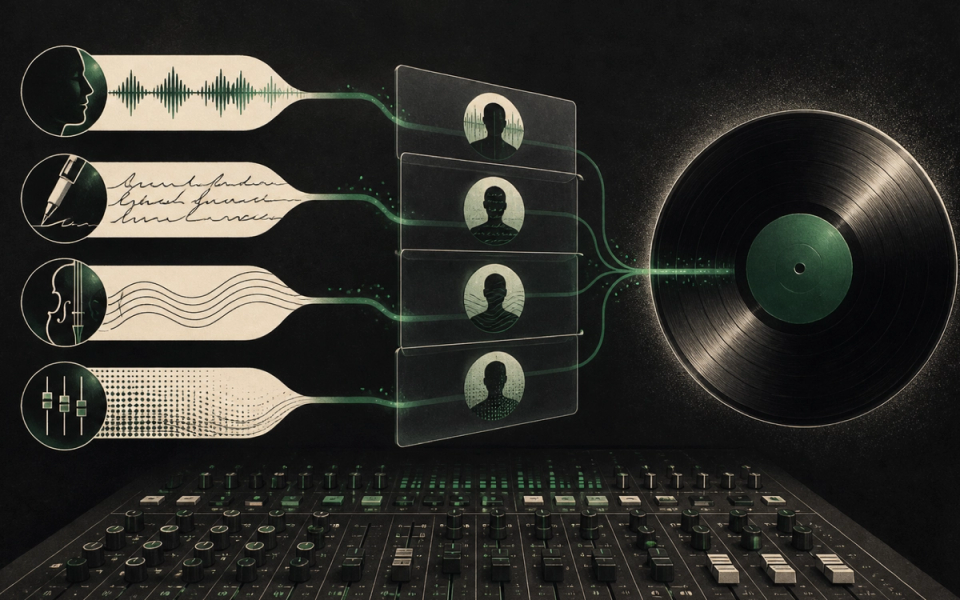
AI mixing is a broad label. One system may predict levels across uploaded stems. Another may analyze one track and suggest an EQ curve. A plugin may detect masking between two channels. An online service may build a complete mix, while an analyzer only reports possible problems.
These systems usually combine signal analysis, learned profiles, rules, references, or machine-learning models. They can estimate properties such as level, spectrum, dynamics, stereo width, transients, pitch, timing, and source class, then map those measurements to processing decisions.
That does not mean the system understands why the second verse should feel smaller, why a rough vocal should stay exposed, or why a reference is intentionally wrong for the bridge. It means the system can make repeatable decisions from the information its design accepts.
Where AI mixing works well
Fast starting points
Level balance, broad tonal correction, masking suggestions, and initial dynamics are time-consuming when a session is large. A system such as RoEx Automix can process prepared stems into a complete candidate, while iZotope Neutron’s assistant can build an editable starting point inside the DAW.
The word “starting” is important. A first pass can remove the fear of an empty mixer and reveal arrangement problems. It does not have to be the final artistic statement to be valuable.
Repeatable technical checks
Software is good at measuring the same properties the same way every time. Loudness, true peak, clipping, crest factor, tonal distribution, and stereo correlation are useful examples. Vendor-independent standards such as the EBU loudness framework show why consistent measurement matters even when creative targets differ.
AI-assisted analysis is particularly useful before delivery. It can catch a clipped export, unexpected sub energy, an overly wide low end, or a master that changed much more than intended.
High-volume and low-risk work
Demos, rehearsal recordings, creator videos, catalog previews, alternate versions, and rapid pitches often need a competent result quickly. When the alternative is no mix at all, automation can make publishing and decision-making possible.
Narrow, well-defined corrections
An intelligent EQ or compressor can be effective when the engineer already knows the role of the track. “Control this vocal’s inconsistent level without dulling consonants” is a narrower and more testable task than “make the chorus emotionally devastating.”
Learning and comparison
An automated result is a useful reference. If its balance translates better than your manual mix, compare faders, low-end distribution, dynamics, and vocal level. The goal is not to copy every setting; it is to identify which decision improved the outcome.
Where human mixing works better
Artistic hierarchy
A mix is not an equal distribution of clarity. Someone decides what the listener should notice first, what can remain mysterious, where energy should grow, and which imperfection belongs to the performance. That hierarchy changes by section and by artist.
Peer-reviewed Audio Engineering Society research on context-aware intelligent mixing distinguishes human ability to comprehend and apply context from the narrower information available to an intelligent system. That gap is central to creative work.
Ambiguous feedback
Artists say “make it warmer,” “the chorus is not opening,” or “the vocal feels too expensive.” A human engineer can ask questions, infer references, test an interpretation, and explain a tradeoff. A preset can only map the input to controls it recognizes.
Arrangement and production intervention
The best mix decision may be muting a guitar, shortening a reverb throw, replacing a kick, editing a breath, changing a synth octave, or asking for a new vocal take. Those are production decisions, not merely channel processing.
Exceptions and intentional damage
Some records need a narrow intro, overloaded drum bus, distorted vocal, unstable tape, abrupt automation, or deliberately quiet master. A human can understand that the “problem” is the aesthetic. An automated system may normalize away the reason the track is memorable.
Albums and release systems
Mastering and mixing across an EP or album require continuity. A human can sequence songs, preserve meaningful contrasts, manage revisions across tracks, check metadata and deliverables, and consider vinyl, instrumental, clean, performance, and sync versions.
BandLab’s own mastering guide notes limits beyond stereo processing, including sequencing, error judgment, metadata, multiple delivery formats, and physical formats. Those responsibilities are easy to miss when “mastered” means one downloaded WAV.
Accountability and communication
A professional engineer can explain what changed, recall the artist’s priorities, provide version control, and accept responsibility for the delivery. The value is partly sonic and partly operational.
Human mixes are not one objective answer
Audio Engineering Society research analyzing 1,501 mixes across ten songs found meaningful variation in dimensions including amplitude, brightness, bass, and width. That is an important correction to the idea that one algorithm must discover the hidden correct mix.
Different engineers can create valid mixes from the same multitracks. Their choices reflect taste, monitoring, genre expectations, experience, references, and the requested brief. Automation may model common decisions, but creative mixing includes choosing which common decision not to make.
A practical decision matrix
Choose AI-first when:
- The budget cannot support a professional engineer.
- The release is a demo, pitch, internal preview, or frequent low-risk format.
- Stems are clean, labeled, aligned, and conventional.
- Turnaround matters more than deep revision dialogue.
- You need several quick candidates for comparison.
- The goal is a technical check or starting balance.
Choose human-first when:
- The song is a priority single, label release, sync pitch, or permanent catalog asset.
- The production has unusual structure, sound design, live bleed, or intentional distortion.
- Artist feedback is emotional or difficult to translate into parameters.
- Several songs must feel like one body of work.
- Revisions require conversation and recall of earlier decisions.
- Delivery includes instrumental, clean, performance, immersive, vinyl, or complex stem packages.
Choose hybrid when the budget supports limited human time. Automation can prepare and diagnose; the engineer can spend attention on choices that affect identity and release risk.
A hybrid workflow that avoids double work
- Finish editing and arrangement before mixing.
- Clean file names, align starts, remove silence, and export lossless stems when needed.
- Preserve an untouched version and document sample rate, bit depth, tempo, and references.
- Run an automated balance or assistant once to expose obvious issues.
- Import the result or observations into the human-led session; do not stack multiple automatic mixes.
- Decide the focal element and energy curve for each song section.
- Make the static mix with level, pan, polarity, and basic filtering before adding complex processors.
- Use intelligent plugins only where a defined problem exists.
- Compare the mix and master at matched loudness against references and prior versions.
- Check the full song on several playback systems.
- Run a final automated QA pass for clipping, loudness, stereo, and tonal anomalies.
- Let a person approve the release file, name, metadata, version, and deliverables.
This division keeps automation from making aesthetic decisions by accident while preserving its speed on measurable work.
Cost is more than the invoice
Automated tools can be inexpensive per song, but count preparation, upload, cleanup, subscription, revision, and migration time. A cheap result that requires rebuilding the mix is not cheap.
Human mixing costs more upfront, but may include production advice, recalls, alternate versions, delivery management, and a reliable outside perspective. Confirm what the quote includes: number of revisions, stem mix, vocal-up and vocal-down versions, instrumental, clean edit, master, archive period, and turnaround.
If the budget is fixed, spend human money where mistakes are hardest to reverse. That may mean paying for vocal editing and final mastering while using an assistant for the first mix. It may mean hiring a mix engineer for the lead single and using the approved sonic template for lower-priority content.
Privacy and ownership
Cloud AI mixing requires uploading unreleased audio. Read how long files remain, whether staff or subprocessors can access them, whether material trains models, how deletion works, and what happens after cancellation. Client agreements may prohibit external upload even when the service itself promises not to train.
Mix processing normally does not transfer ownership of the song or master, but contracts can still govern uploaded content, platform licenses, and deliverable access. Save the terms that applied to the project.
For more product context, see Doldur Music’s indexed RoEx review and our broader AI music trends overview.
Frequently asked questions
Can AI replace a mixing engineer?
It can replace some tasks and sometimes produce a usable full mix. It does not reliably replace artistic interpretation, conversation, unusual production decisions, album continuity, or delivery accountability.
Is AI mixing good enough for professional release?
Sometimes, especially with strong source material and conventional arrangements. Professional use still requires full-song listening, translation checks, technical QA, and confirmation that the result serves the artist’s intent.
Is human mixing always better?
No. Skill, monitoring, communication, genre experience, time, and fit vary between engineers. Evaluate portfolios, process, references, and a test mix when appropriate.
Should I send AI-processed stems to a human engineer?
Send both the raw consolidated stems and any processed reference that communicates the intended sound. Do not force the engineer to undo irreversible limiting, clipping, denoising, or effects unless those sounds are intentional.
Where does AI mastering fit?
Use it after the mix is finished as a candidate, diagnostic comparison, or low-risk delivery. A human master is more valuable when sequencing, unusual formats, repair decisions, or release accountability matter.
Verdict
AI mixing wins on speed, repeatability, measurement, and accessible starting points. Human mixing wins on context, taste, communication, exceptions, and responsibility. Neither label guarantees quality.
Use automation for the work that becomes safer when repeated consistently. Use human attention where the song requires interpretation. The hybrid model is not a compromise; it is often the most efficient way to spend both computing time and creative judgment.
Sources and further reading
- Context-Aware Intelligent Mixing SystemsPeer-reviewed distinction between machine and human use of production context.
- Variation in Multitrack MixesAnalysis of variation across 1,501 human mixes and major dimensions of mix difference.
- RoEx Automix HelpCurrent automated mixing scope, input constraints, exports, and cloud workflow.
- iZotope Neutron 5Current AI assistant positioning, editable modules, and in-DAW controls.
- BandLab Mastering GuideProvider explanation of automated mastering limits and human mastering responsibilities.
- EBU LoudnessVendor-independent measurement and normalization framework.