guide
Artist Website vs Link in Bio: Which Do You Need?
Compare an artist website with a link-in-bio page, see where specialist music links fit, and choose the smallest useful setup for your next campaign.
Disclosure: Doldur Music may earn a commission if you sign up for Promake through links in this article, at no additional cost to you. We describe only features we could verify from current public information.

The artist website vs link in bio decision is not a contest between a “professional” option and an inferior shortcut. They are different formats. A link-in-bio page is a fast menu for people arriving from social media. An artist website is an owned destination that can explain the project, organize releases, serve press and booking needs, and keep durable pages online.
Many musicians need both. The useful question is which job should lead today, and whether the extra structure of a website will be maintained.
Key points
- Choose a link-in-bio page when the immediate job is routing social visitors to a few current destinations.
- Choose an artist website when visitors need context, separate pages, a custom identity, press material, or a permanent contact route.
- Use both when social profiles need a short menu but the artist also has deeper owned pages.
- Do not assume every link page provides automatic music matching, pre-save, analytics, or fan capture; features depend on the provider.
- A manually built release page can collect platform buttons, but that does not make it an automatic music smart link.
Artist website vs link in bio at a glance
The difference is depth. A link-in-bio page reduces choice to a compact list. A website creates a small information system with its own hierarchy.
Decision point
Link-in-bio page
Artist website
Best first job
Route social traffic quickly
Explain and organize the artist
Typical depth
One compact page
One rich page or several pages
Setup effort
Usually lower
Usually higher
Visual identity
Template and provider dependent
More room for a complete identity
Permanent content
Possible, but often campaign-led
Strong fit for durable pages
Press and booking material
Limited by format
Can support EPK, shows, credits, and contact
Custom domain
Provider dependent
Common and recognizable
Automatic music matching
Provider dependent
Not inherent
Pre-save and analytics
Provider dependent
Requires verified tools or integrations
Maintenance
Update a short list
Maintain pages, dates, links, and assets

This table is a format comparison, not a promise about every service. Link-in-bio providers vary widely. Some are simple lists; others add storefronts, email capture, smart links, pixels, or analytics. Verify the exact plan and privacy implications before relying on a feature.
When a link-in-bio page is enough
A link page is enough when the visitor already knows the artist and only needs a short set of destinations. This is common for traffic arriving from Instagram, TikTok, YouTube, or a QR code at a show.
It works particularly well when:
- the project has one current release or campaign;
- the artist is not ready to maintain several pages;
- every important destination fits in a short list;
- the primary audience comes from mobile social profiles;
- speed matters more than extended context;
- press and booking material live somewhere else;
- a specialist music-link provider supplies a verified feature the campaign needs.
The discipline is to keep the list short. Put the current action first, label each destination clearly, and remove expired campaigns. A page with fifteen equal buttons simply moves the social-profile problem to a new screen.
Do not make visitors decode clever labels. “Listen to the new single,” “Upcoming shows,” “Watch the live session,” and “Booking enquiries” explain what happens next. Generic labels such as “More,” “Explore,” or “Enter” add friction without adding identity.
Where an artist website becomes more useful
An artist website is the better fit when visitors need more than a menu. It can give each important job enough space and a stable URL.
The project needs a complete introduction
A new listener may need a short description, current music, a photo, and one clear next step on the same screen. A journalist may need the exact artist spelling, location, biography, credits, and approved images. A promoter may need live footage, set information, and booking contact.
A website can provide those routes without forcing everyone through the same button stack.
Content should remain available after the campaign
Release campaigns change quickly. The artist identity, selected catalogue, press information, and contact route should not disappear when the newest link moves down the list.
Permanent pages also create sensible destinations for interviews, venue listings, video descriptions, and press coverage. The value is continuity, not a guarantee of search rankings.
The artist needs a custom information structure
An owned site can separate Music, About, Shows, EPK, Contact, and Store when each section has enough material. It can also remain one page when the project is small. The key advantage is that the structure follows the artist’s visitor jobs rather than a provider’s fixed list format.
Brand and context matter as much as the links
Artwork, typography, pacing, image selection, and writing establish how the project feels before a visitor presses play. A compact link page can carry identity, but its format usually gives that identity less room.
The website should still resist decoration for its own sake. Motion, texture, and unusual navigation are useful only when the music and next action remain obvious.
Where specialist music links are stronger
A dedicated music-link or pre-save provider may be stronger when the campaign needs platform-specific behavior rather than a manually maintained page.
Depending on the provider and plan, specialist features may include:
- automatic matching of a release across music services;
- pre-save or pre-add actions before release day;
- deep links that open a mobile app;
- country or device-based routing;
- campaign analytics;
- advertising pixels;
- email or fan-data capture with consent controls.
These are not universal features, and they are not inherent to an owned artist website. Check the product documentation, supported territories, data handling, and plan details. If a website builder lets you place three service buttons on a page, describe the result as a manual multi-platform landing page.
That distinction protects the reader from choosing a tool for a feature it does not actually provide.
How to use a link in bio and an artist website together
The combined model is simple: the social profile uses one short entry point, and that entry point routes people to the artist’s most useful owned pages and specialist services.
A practical order might be:
- New release
- Upcoming shows
- Official artist website
- EPK or booking
- Store
- Newsletter
The artist website then holds durable material: biography, release archive, selected video, press assets, contact information, and policies. A release button may go to an owned landing page or to a specialist smart link, depending on the campaign.
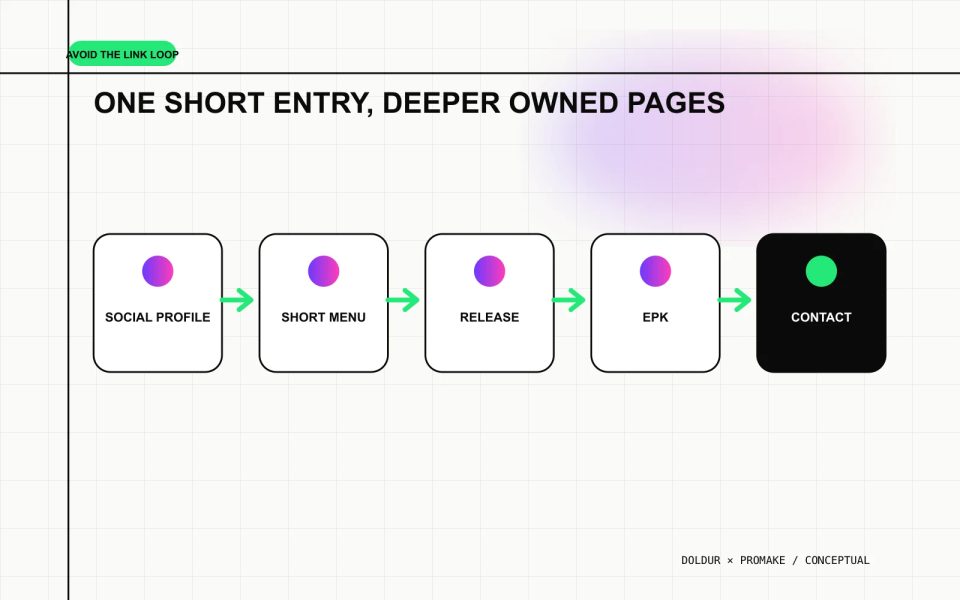
Avoid loops. The website should not send a visitor to a link page that immediately sends them back to the website. Choose one layer as the compact menu and one as the deeper destination.
A decision tree for your current stage
Start with the smallest format that covers the real visitor job.
Choose a link-in-bio page if:
- you need a working mobile menu today;
- you have fewer than six important destinations;
- most visitors already know who you are;
- there is little permanent material to explain;
- you will reliably keep one list updated.
Choose an artist website if:
- journalists, promoters, clients, or collaborators need context;
- you need separate Music, Shows, EPK, Portfolio, Store, or Contact sections;
- you want a recognizable domain and professional contact;
- you have durable material beyond one campaign;
- you can maintain the site when releases, dates, and links change.
Choose both if:
- social traffic needs a compact entry point;
- the artist also has deeper pages;
- a specialist music link handles campaign functions the website should not imitate;
- each layer has a clear, non-duplicated job.

Building the owned website layer with Promake
Promake’s current public documentation describes an AI-first website builder that works from a conversational brief. It also documents publishing on a hosted link, custom-domain management, professional email options, a visual edit tool, and paid-plan commerce or payment capabilities.
That makes Promake relevant to the owned website side of this comparison. It does not establish automatic music-service matching, pre-save, fan analytics, or a dedicated booking system. Connect a specialist service when the campaign requires one of those jobs.
Before building, prepare the artist name, short description, approved photos, official music destinations, contact route, and main action. Then describe whether you need one page or a small multi-page site. Use the complete musician website guide for the build workflow, the musician website pages checklist for structure, and the music smart-link guide when automatic platform functions matter.
If you want to build the owned layer now, create an artist website with Promake. Check the current plan and domain terms before committing.
Keep the decision reversible
You do not have to design the final system on day one. A focused link page can serve the first release. An owned one-page site can appear when the biography, contact, and catalogue need more room. Separate EPK, Shows, or Store pages can follow when real material exists.
Do not build empty pages because a checklist says every musician needs them. Do not keep a link page so long that journalists and bookers must assemble the project from scattered profiles. Choose the format that removes the current friction, then review it after the next release or campaign.
FAQs
Is a link-in-bio page the same as an artist website?
No. A link page is usually a compact routing page. An artist website can be one page or many, but it typically provides more context, durable content, custom structure, and room for press or booking material.
Do I need a website if my link page has a custom domain?
A custom domain improves recognition, but it does not change the page’s depth. If a compact list answers every visitor need, it may be enough. Add a fuller website when the project needs context, permanent pages, or separate audience routes.
Can an artist website replace a music smart link?
It can collect manually added listening buttons under one URL. It does not automatically provide service matching, pre-save, deep links, analytics, or fan capture unless those functions are verified in the chosen tools.
Should the artist website link back to the link-in-bio page?
Usually not. That creates an unnecessary loop. Let the social-profile link act as a compact menu, then point its buttons directly to the owned website, release page, EPK, store, or specialist service.
Which option is cheaper?
Costs vary by provider, plan, domain, email, and specialist features. Compare the complete setup you need, not only the entry price. Recheck current pricing before purchase.