analysis
Copyright Guide for AI-Separated Stems
AI separation changes an audio file, not its rights. Map the master, composition, contracts, tool terms, intended use, permissions, and evidence before release.
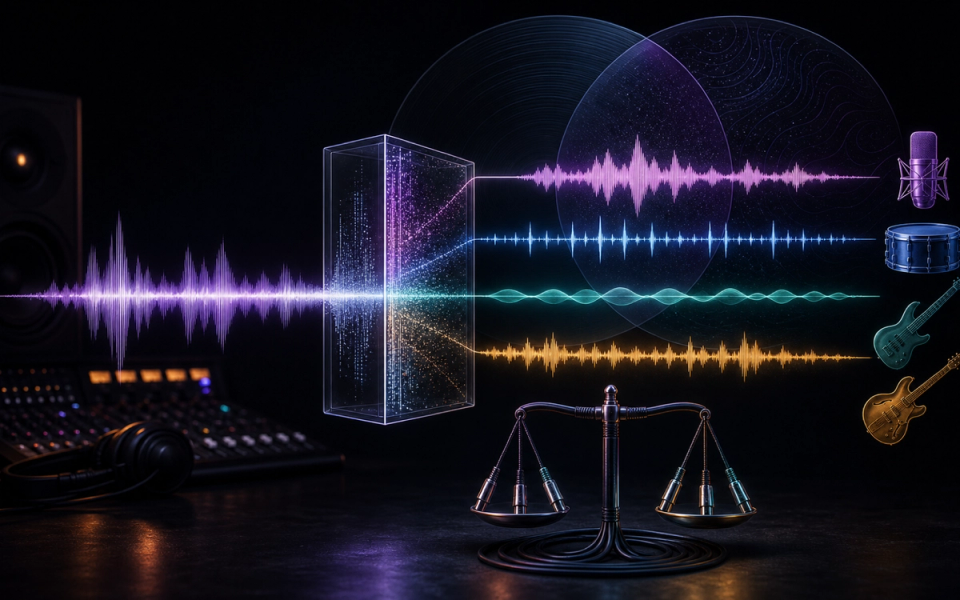
AI stem separation changes an audio file, not the rights attached to it. If you split a released recording into vocals, drums, bass, and other parts, the resulting files can still contain protected sounds from the master recording and protected music or lyrics from the underlying composition. A cleaner vocal or isolated drum part is not automatically free to remix, sample, share, sell, or train a model on.
The safest rule is simple: if you did not create and control the source recording, identify the owners and the intended use before distributing anything made from the separated stems. A technical ability to extract audio is not a license.
This guide explains a practical United States framework for producers and independent artists. Copyright rules, exceptions, contracts, performer rights, and moral rights vary by country. It is general information, not legal advice.
Key points
- A song commonly involves at least two copyright layers: the musical composition and a particular sound recording.
- Stem separation usually recaptures and rearranges sounds from the source master; it does not create an independently recorded performance.
- Owning a download, CD, or streaming subscription does not transfer the copyrights in the music.
- A composition license does not necessarily clear the master recording, and a master-use permission does not necessarily clear the composition.
- There is no automatic “short sample,” “noncommercial,” “educational,” or “AI-processed” exemption.
- Fair use is fact-specific. No fixed number of seconds, notes, or percentage guarantees safety.
- Separating your own multitrack recording is normally the cleanest case, but collaborators, samples, beats, and contracts can still divide the rights.
- Keep the source, permissions, contracts, model or tool terms, project history, and release decision together.
Start with the two copyright layers
The U.S. Copyright Office treats a musical composition and a sound recording as distinct works. The composition covers music and any lyrics. The sound recording covers a particular fixed performance and production.
That distinction matters because a separated vocal can contain both layers at once. The actual recorded voice, processing, and production belong to the sound-recording layer. The melody and lyrics embodied in that performance belong to the composition layer. An extracted guitar phrase can likewise preserve the recorded performance and the underlying musical material.
Rights may be held by different people or companies. A label may control a master while a publisher or several songwriters control the composition. Performers, producers, featured artists, unions, sample licensors, and distributors may have additional contractual interests. Never assume that one approval clears every layer.
The Copyright Office’s current Circular 73A makes the separation concrete: the compulsory mechanical license for a nondramatic musical work does not cover the existing sound recording. Making a new recording of a licensed composition and reusing actual sounds from an existing master are different acts.
What stem separation does legally
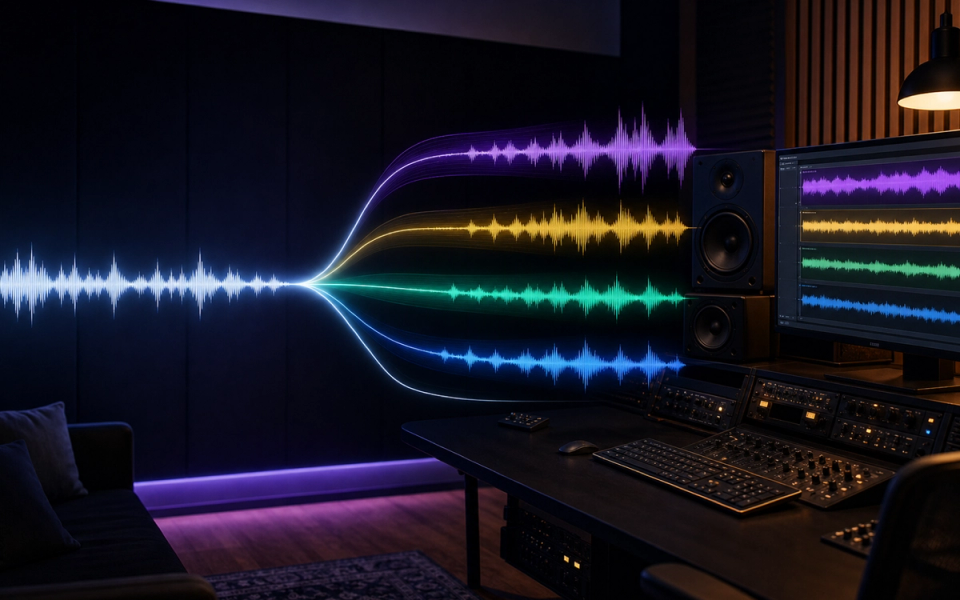
Stem-separation software estimates components inside a mixed recording. It may produce useful working files, but the vocal, drum, or instrumental output normally contains actual sonic material derived from the source file.
Section 114 of the U.S. Copyright Act describes the sound-recording owner’s derivative-work right in terms of actual recorded sounds being rearranged, remixed, or otherwise altered in sequence or quality. That language is directly relevant to common separation workflows. Removing accompaniment, changing balance, cleaning artifacts, pitching a vocal, or rebuilding a remix around extracted audio can alter the sound without replacing it with an independent fixation.
The file format does not change that conclusion. WAV instead of MP3, mono instead of stereo, an instrumental instead of a full mix, or a model-generated mask instead of a traditional filter are technical differences. They do not by themselves create permission.
Five common scenarios
1. You own the composition and master
This is the lowest-friction case. If you wrote the song, recorded the performance, paid or contracted collaborators correctly, and own the master, you can usually separate the track for remixes, practice versions, sync delivery, accessibility, karaoke, or archival work within your existing agreements.
Still check for third-party material. A licensed beat, nonexclusive instrumental, sample-pack vocal, cleared sample, session-player agreement, or producer contract may limit extraction, sublicensing, or distribution. Ownership of the final master does not expand the original license for every ingredient.
Our AI stem-separation guide covers the technical workflow and quality limits. The rights audit should happen before uploading or delivering the outputs.
2. You have multitracks from a client or collaborator
Possession is not the same as authority. A mix engineer may receive stems solely to perform a defined service. A remix contest may permit downloading files but restrict the platform, release window, monetization, or ownership of submissions.
Read the agreement for purpose, territory, term, permitted edits, security, deletion, publicity, portfolio use, model training, and delivery. Get written confirmation when the requested use goes beyond the original job.
3. You separate a commercially released song
Private analysis, transcription, practice, DJ preparation, public remixing, sampling, and commercial release are not one legal category. Distribution raises the risk because it may exercise reproduction, derivative-work, distribution, composition, and public-performance rights.
Do not assume that attribution, a disclaimer, purchasing the track, or giving the remix away substitutes for permission. If the release reuses actual sounds, identify the master owner. If it uses protected melody or lyrics, identify the composition owners as well. A distributor accepting an upload is not a clearance decision.
4. You remove vocals for karaoke, sync, or social video
An instrumental made by extraction still contains the underlying master. Adding it to video can require synchronization permission for the composition and permission for the recording. Platform music libraries may provide limited in-product permissions, but those permissions should not be exported mentally to another service, advertisement, client, or standalone release.
If a client needs stems for film, television, games, or advertising, deliver material from the rights holder or an authorized source. Do not manufacture unofficial stems from a consumer master and present them as cleared assets.
5. You use extracted material as AI input
Uploading a recording to a tool adds a contractual and data-handling question to the copyright question. Check whether the service stores uploads, uses them to improve models, permits confidential material, grants itself a license, exposes files to collaborators, and supports deletion.
Authority to create one remix does not automatically include authority to upload the source to a third party for training or generation. Separate permission may be needed. Our broader AI music licensing overview explains why input rights and output rights must be examined separately.
Does AI create a new copyright in the stems?
Running a separation model is not a reliable way to manufacture ownership of someone else’s audio. The U.S. Copyright Office’s 2025 AI report says copyright can protect AI-assisted work when a human determines sufficient expressive elements, but prompts alone do not provide control over expressive output. Creative human selection, arrangement, or modification may be protectable to the extent of that new contribution.
That protection, if any, does not erase preexisting rights. Section 103 of the Copyright Act says copyright in a derivative work extends only to new material contributed by its author and does not enlarge rights in the underlying work. It also denies protection to unlawfully used preexisting material.
Artifact cleanup, gain changes, pan changes, phase alignment, and choosing a model may be technically skilled. Whether a particular result contains copyrightable human authorship is a separate, fact-specific question. Even a protectable remix can require authorization to use the source.
What about fair use?
Fair use is not a stem-separation license. It is a case-by-case doctrine evaluated through purpose and character, nature of the work, amount and substantiality used, and market effect. Songs and studio recordings are highly creative works, and an isolated hook or vocal may represent the heart of a work even when it is short.
The Copyright Office emphasizes that there is no formula based on a fixed number of words, notes, seconds, or percentage. Noncommercial and educational purposes can matter, but they do not automatically win. “Transformative” also does not mean merely applying a technical transformation; courts evaluate whether the use adds a different purpose or character and how it affects relevant markets.
If a project depends on fair use—especially a monetized remix, documentary, dataset, product, or disputed release—obtain advice based on the actual files, territory, and distribution plan.
A clearance workflow before release
1. Record the source
Save the source title, recording artist, release, label, ISRC if available, songwriters, publishers, platform, acquisition date, and exact file used. Screenshots alone are weak; preserve the relevant URL and terms version.
2. Describe the intended use precisely
Write down whether the output is for private practice, internal production, a public remix, a sample, a cover, a sync placement, karaoke, a live show, model input, a client deliverable, or a commercial release. Include territory, platforms, audience, monetization, term, and whether third parties can reuse the result.
3. Map every rights layer
Ask who controls:
- The source master recording.
- The music and lyrics.
- Any embedded samples or interpolations.
- Featured performances and producer contributions.
- The separation tool and its upload/output terms.
- Artwork, video, names, and likenesses used with the release.
4. Obtain matching written permissions
Permission should name the actual recording and composition, permitted audio, edit, release, territory, duration, media, monetization, credits, fees or royalties, sublicensing, warranties, and takedown process. A casual message may be ambiguous when a platform or client asks for proof.
5. Verify the output
Listen for material the model assigned to the wrong stem. A “drum” stem can contain vocal fragments, melody, room sound, or reverb from the full master. A license limited to one element may not cover leakage from another.
6. Keep an evidence package
Store the permission, contract, source metadata, tool terms, separation date, tool and version, original file hash, output files, project file, cue sheet or split sheet, and distributor correspondence. The package should let a future label, platform, publisher, or lawyer reconstruct the decision.
What permission does not guarantee
Permission reduces copyright risk, but it does not guarantee that automated systems will recognize the release. Shared source audio can trigger fingerprint matches. A distributor may ask for master and composition evidence. A rights holder can also make a mistake or change administrators.
Build time for claims into the release plan. Use accurate metadata, avoid claiming exclusive ownership over licensed nonexclusive material, and respond with the narrow documentation relevant to the flagged element. Do not submit someone else’s isolated stem to a fingerprint or content-claim system as if it were exclusively yours.
Practical decision table
Source
Intended use
Default next step
Your fully controlled master
Private or commercial production
Check collaborator and sample agreements, then document the separation
Client or collaborator files
Work within the commission
Follow the written scope; request permission for anything broader
Released third-party master
Remix, sampling, sync, or distribution
Clear the master and composition rights that the use requires
Public-domain composition, modern recording
Reuse of actual recorded sounds
The composition may be free while the recording remains protected
Licensed sample or beat
Extraction or resale as a component
Read the license for isolation, redistribution, sublicensing, and Content ID
Any third-party source
AI upload or model input
Confirm copyright authority and the service’s data license before upload
Final checklist
- I can identify the master and composition separately.
- I know who controls each required right.
- My permission covers the exact source, output, territory, term, platform, and commercial use.
- The service terms allow me to upload the source and use the output as planned.
- I checked collaborators, samples, beats, and prior contracts.
- I did not rely on a seconds, notes, percentage, credit, or noncommercial myth.
- I inspected the separated file for leakage from other elements.
- I kept the source, permissions, terms, project history, and release metadata.
- I know who will handle platform claims or takedown notices.
- I will obtain jurisdiction-specific advice if the release is valuable, disputed, or dependent on an exception.
Stem separation is useful because it reveals and reorganizes a recording. That same fact explains the copyright caution: the process usually preserves protected material rather than replacing it. Clear the use, not just the file.
Sources and further reading
- U.S. Copyright Office Circular 56ACurrent distinction between musical compositions and sound recordings and their separate rights.
- U.S. Copyright Act, Chapter 1Sections 101, 103, 106, 107, and 114 on derivative works, exclusive rights, fair use, and recorded sounds.
- U.S. Copyright Office Circular 73ACurrent explanation that the Section 115 compulsory license covers compositions, not existing masters.
- U.S. Copyright Office Fair Use IndexFour-factor framework, case-specific analysis, and warning that no fixed amount guarantees fair use.
- Copyright and Artificial Intelligence, Part 2Current U.S. Copyright Office analysis of human authorship, AI assistance, prompts, selection, and modification.
- U.S. Copyright Office Circular 56Current sound-recording guidance, including derivative recordings and underlying works.