guide
Stem Separation vs Source Separation: What Is the Difference?
Stem separation and music source separation often name the same unmixing process, but estimated sources are not the same as original production stems.
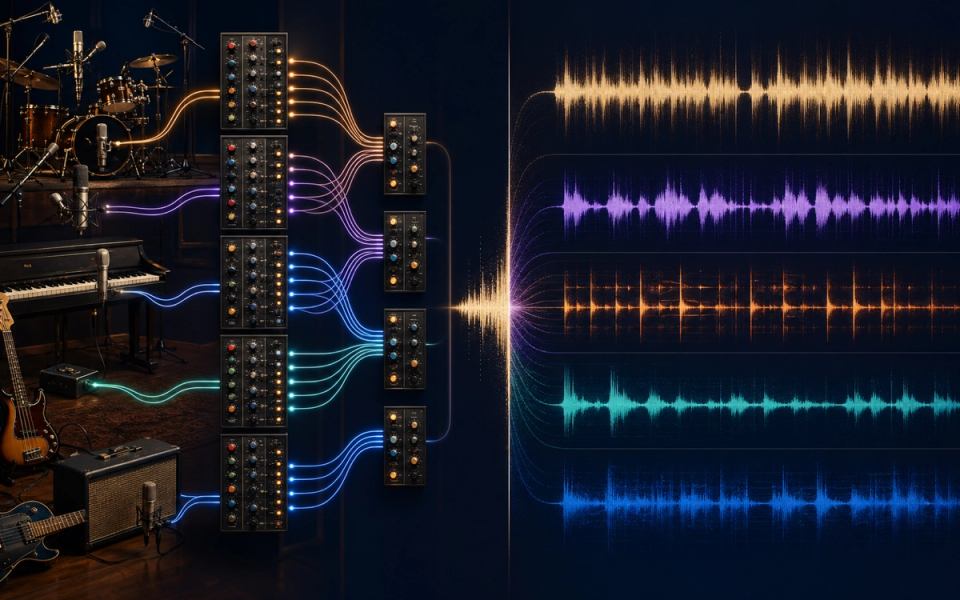
In current music software, stem separation and music source separation usually describe the same process: estimating vocals, drums, bass, instruments, or other components from a mixed audio file. The important distinction is not between those two product labels. It is between AI-estimated sources and the original stems or multitracks exported from the recording session.
Confusion happens because “stem” already had a production meaning before AI unmixing tools became common. A mixer may deliver real drum, vocal, band, and effects stems created by routing original tracks into groups. A separation model receives only the finished mixture and tries to reconstruct similar categories. Both outputs may be called stems, but their origin, fidelity, and legal context are different.
Key points
- Ableton explicitly describes stem separation as another name for music source separation.
- Source separation is the broader technical field; “stem separation” is common music-product language.
- Original production stems are deliberate group exports from the multitrack session.
- AI-separated stems are estimates derived from an already mixed signal.
- Estimated parts may contain leakage, missing detail, or reconstructed artifacts.
- Choose original stems whenever exact fidelity, reversibility, and documented rights matter.
What is music source separation?
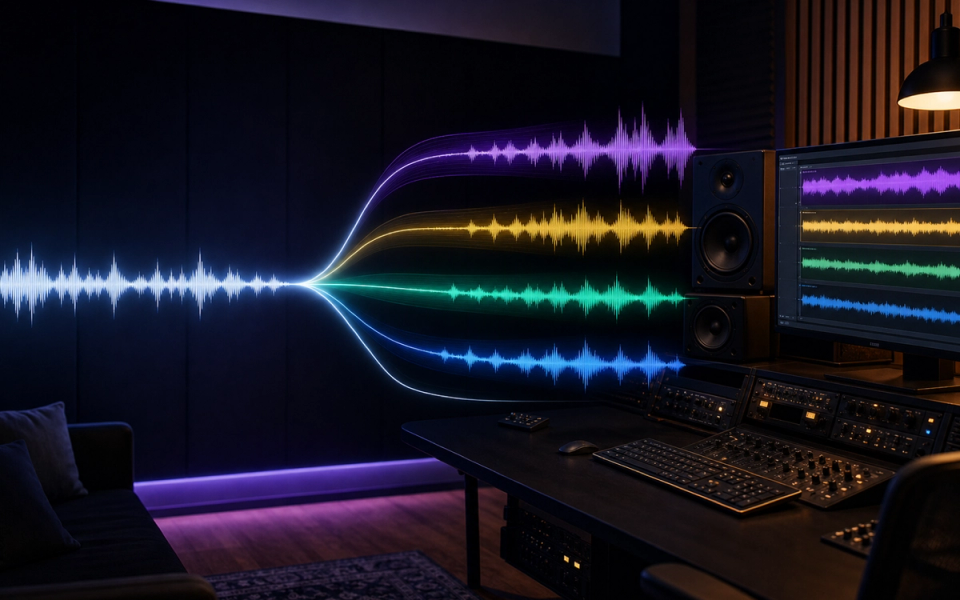
Source separation is the technical task of isolating individual signals from a mixture. In music, the targets are often vocals, drums, bass, and a residual “other” category. Research systems can also target guitar, piano, strings, speech, effects, or a source described by a query.
The MUSDB18 dataset illustrates the common research setup. It contains stereo mixtures alongside isolated drums, bass, vocals, and other sources. Models learn or are evaluated by comparing their estimates against those known reference signals. The model sees a mixture and predicts the components that could have produced it.
That is an inverse problem. During mixing, signals are summed after processing, automation, panning, compression, reverberation, distortion, and limiting. Separation works in the opposite direction without access to every original decision. More than one set of sources could plausibly explain the same two-channel waveform, so the result is an estimate rather than a recovered project file.
What is stem separation?
In modern DAWs and consumer services, stem separation is the music-facing name for that same unmixing task. Ableton’s manual states directly that stem separation is also called music source separation and explains that it analyzes spectral and temporal characteristics to extract detected components into parts called stems.
The term is useful because producers understand a vocal stem or drum stem as an audio file they can mute, edit, or rebalance. Product interfaces therefore say “split into stems” even when the underlying engineering literature says “estimate target sources.”
There is no reliable rule that software using one label employs a fundamentally different technology from software using the other. Compare the actual targets, processing location, model, output format, and quality controls instead of assuming the name decides the method.
What are original production stems?
Original stems are created from the multitrack session. A mixer routes related tracks to group buses and exports those groups from the same start point. A drum stem might include kick, snare, toms, overheads, room microphones, samples, and drum-bus processing. A vocal stem might combine lead, doubles, harmonies, tuning, effects returns, and automation.
Because the groups come from the original sources, they can usually reconstruct the approved mix closely when summed at unity with the intended processing. Deliverables vary: an instrumental, acapella, TV mix, clean version, score groups, dialogue/music/effects, or detailed instrument packages may all be called stems in professional contexts.
Production stems are not always raw multitracks. A stem can contain many printed tracks and bus effects, while a multitrack delivery may contain each microphone or instrument separately. The exact definition belongs in the delivery specification.
What are AI-estimated stems?
AI-estimated stems begin with the final mixture. A model predicts which parts of the signal belong to requested categories and renders new audio files. Demucs, for example, documents common drums, bass, vocals, and other outputs, plus an experimental broader model. AudioShake describes comparable separation for remixing, post-production, sync, and catalog work.
The estimated files can be extremely useful. They allow a producer to reduce vocals when the instrumental is missing, isolate a bass line for study, restore an archive, create a localization bed, or prepare a creative sketch. Their usefulness does not make them identical to the originals.
An estimated vocal may include cymbal leakage because cymbals and consonants share high-frequency energy. A guitar may partially enter the vocal estimate when both occupy similar pitch and stereo space. Reverb may be split across categories. The sum of estimated parts can differ from the original because the model introduced errors or the software adjusted levels to prevent clipping.
Why the terminology matters
If a collaborator asks for “the stems,” answering with AI estimates without explanation can create a costly misunderstanding. The recipient may expect official session exports suitable for remix approval, immersive mixing, or archival delivery. Estimated files may be fine for a mock-up but unsuitable for the final master.
Use precise labels in filenames and communication:
- Original multitracks: individual session recordings or printed tracks
- Production stems: grouped exports created from the original session
- AI-separated stems: model-estimated categories derived from a mix
- Instrumental estimate: mixture with the predicted vocal reduced or removed
- Vocal estimate: predicted vocal extracted from the mixture
This wording preserves provenance. It also prevents an estimated file from being archived later as if it came from the artist’s original session.
A simple signal-flow comparison
Original production flow:
- Individual recordings and programmed parts enter the DAW.
- The mixer processes and routes them to groups.
- Group buses are printed as stems.
- The stems and mix retain documented session provenance.
AI separation flow:
- A finished stereo or mono mixture enters the model.
- The model analyzes patterns associated with target sources.
- It predicts vocal, drum, bass, instrument, or residual signals.
- New files are rendered as estimates.
The second path cannot restore automation data, plugin settings, unprocessed recordings, microphone choices, MIDI, or independent effect sends that were not preserved in the mixture.
When estimated sources are good enough
Use AI separation when the purpose tolerates an estimate and the original session is unavailable or too slow to retrieve. Common examples include:
- Practicing or transcribing an instrument
- Building a private arrangement sketch
- Creating a rehearsal backing track
- Reducing a source under dialogue
- Testing a potential remix before requesting official stems
- Restoring an old demo with missing project files
- Searching a catalog for samples or musical components
- Preparing accessibility, lyric, or localization workflows
Judge quality in the final context. A vocal estimate that sounds rough in solo may work beneath a new production. A small amount of leakage may be irrelevant for education but unacceptable for an exposed sync edit.
When original stems are the better requirement
Request original session exports when the deliverable must be exact, auditable, or deeply editable. This includes final remixes, immersive formats, high-value licensing, restoration masters, official instrumentals, broadcast packages, and archive deposits.
Original stems are also preferable when the rights holder must confirm precisely what was used. The session and export notes can identify performances, samples, processing, and approved versions. An estimate can reveal content, but it does not create the original provenance.
If the session no longer opens, a professional recovery process may combine old bounces, consolidated audio, alternate mixes, and separation. In that case, label every reconstructed element and preserve the untouched source.
How to evaluate an AI-separated stem
Start with the actual use case and test the most exposed section. Align the estimate to the mix, preserve headroom, and listen for:
- Leakage from competing sources
- Missing consonants, transients, or note attacks
- Watery or metallic modulation
- Reverb tails moving between categories
- Timing offsets or truncated starts
- Level changes introduced by output normalization
- Phase or cancellation problems in mono
Then sum all estimated parts. Do not expect a perfect null against the source, but check whether the reconstruction remains synchronized and musically coherent. Compare at matched loudness and keep the raw estimate before repair.
Our indexed AI stem separation guide covers artifact control, export choices, and quality limits in more detail.
Do stems automatically include usage rights?
No. Neither original nor estimated stems automatically grant permission to release a remix, sample a performance, or distribute an acapella. The master recording, composition, performances, and samples may have separate rights holders.
An AI tool’s terms govern your relationship with the service, including uploads and outputs. They do not replace permission from music rights holders. For commercial work, document the source file, ownership, purpose, applicable terms, model or service, processing date, and approvals.
See our AI music licensing guide for a practical rights framework.
A better way to ask for files
Replace “send me the stems” with a delivery request that names:
- Whether original session exports are required
- The desired groups or individual tracks
- Included processing and effects
- File format, sample rate, and bit depth
- Common start time and tail length
- Clean, instrumental, TV, and acapella versions
- Whether AI-estimated material is acceptable
- Rights, confidentiality, and archive requirements
Clear specifications eliminate more problems than debating terminology after delivery.
Verdict
Stem separation and music source separation usually mean the same unmixing process in current music tools. The broader technical phrase is music source separation; the producer-friendly phrase is stem separation. Neither phrase guarantees a particular model, output quality, or number of parts.
The meaningful comparison is AI-estimated stems versus original production stems. Estimates come from a mixture and may be useful, flexible, and fast. Original stems come from the session and preserve greater fidelity, control, and provenance. Label the files honestly and choose according to the final use.
Frequently asked questions
Is stem separation the same as source separation?
In music software, usually yes. Source separation is the broader technical field, while stem separation is the common product and production label for estimating musical components.
Are AI-separated stems real stems?
They are usable audio parts commonly called stems, but they are estimates from a mixture. They should not be represented as original session exports.
Can separated stems reconstruct the original mix?
They can produce a recognizable reconstruction, but errors, leakage, normalization, and model processing may prevent an exact match. Original production stems are designed around the session and are better suited to reconstruction.
What is the “other” stem?
In common four-source systems, “other” is the residual category for material not assigned to vocals, drums, or bass. It may contain guitars, keyboards, strings, effects, and leakage from other targets.
Should a mastering or remix engineer receive AI stems?
Only when the engineer understands their origin and accepts them for the job. For final professional work, request original stems first and use estimates as a documented fallback.
Sources and further reading
- Ableton Live 12 Manual — Stem SeparationCurrent product definition explicitly equating stem separation and music source separation.
- MUSDB18 DatasetReference music-separation dataset with mixture and isolated drums, bass, vocals, and other sources.
- Demucs Music Source SeparationModel outputs, evaluation context, and estimated source categories.
- AudioShake Instrument Stem SeparationCommercial use of estimated stems for remixing, post-production, and catalog work.