guide
Best AI Songwriting Tools for Editable Ideas
Choose an AI songwriting tool by the part of the song that is missing: lyrics, chords, melody, MIDI, arrangement, instrumental parts, or a rendered demo.
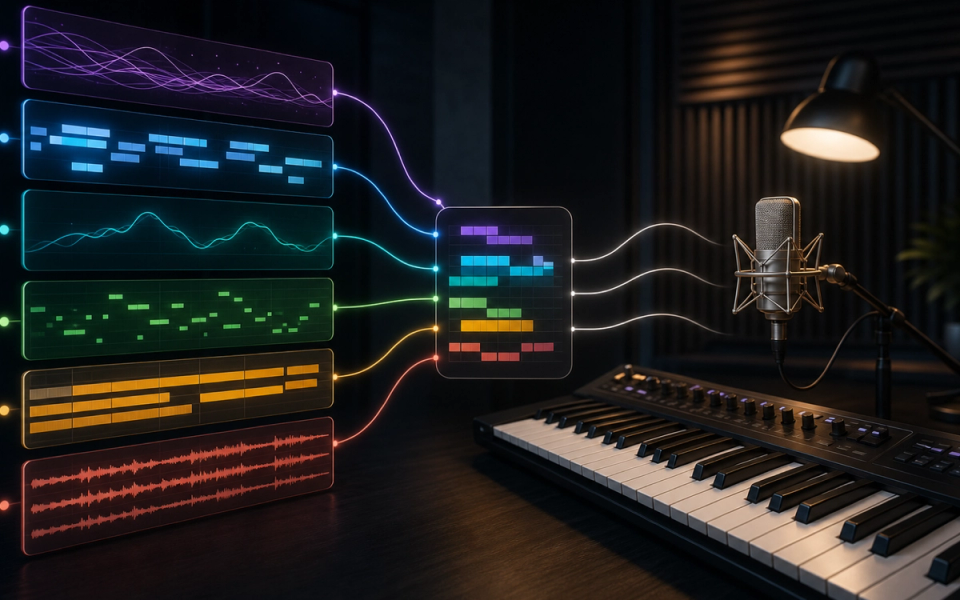
The best AI songwriting tool is the one that solves the missing part without taking away the parts you want to write. Hookpad Aria is strongest for contextual chords and melody. BandLab SongStarter is an accessible way to generate a seed and continue inside a DAW. Lyric Studio focuses on words. AIVA builds longer composition drafts with MIDI export. Eleven Music turns structured sections and lyrics into audio demos. LANDR Layers can add instrumental parts around music you already made.
AudioCipher also belongs in the workflow discussion, but it must be labeled accurately: its text-to-MIDI generator is rule-based, not generative AI. It remains useful precisely because editable output matters more than the marketing label.
Key points
- Choose the missing layer: concept, lyrics, chords, melody, arrangement, instrumentation, or demo.
- Prefer MIDI, notation, stems, or section-level editing when the song must remain controllable.
- Keep your brief and existing material in the workflow; blank-prompt generation throws away useful context.
- Save accepted and rejected versions so you can identify what the tool actually contributed.
- Rewrite generic lyrics, predictable harmony, and overfilled arrangements.
- Check the rights for the exact product and subscription tier before release.
- Treat a generated idea as material to develop, not proof that the song is finished or protected by copyright.
How we chose the shortlist
This comparison uses current official product, support, compatibility, pricing, and rights documentation. We organized tools by songwriting task rather than claiming one system is the universal “best.”
We did not run a controlled private test across every genre, model, and plan, so we do not invent a quality score. Songwriting value is contextual. A two-bar chord answer may be more useful than a polished three-minute demo if the producer wants control over the composition.
Hookpad Aria: best for chords and melody in context
Aria lives inside Hookpad, Hooktheory’s theory-focused songwriting environment. It can suggest chords, melody, or both for a selected region. With existing music, it uses adjacent material plus project key, tempo, and time signature. With a blank project, it can generate a short seed.
That makes Aria useful for specific questions: what harmony could follow this pre-chorus, what melody could sit over these chords, or how could this phrase vary without abandoning the song’s key center?
Hooktheory identifies the underlying model as an adaptation of Anticipatory Music Transformer and explains what project data is sent during generation. Lyrics, section markers, and instrument choices are not part of the relayed context according to the current FAQ. That transparency is useful when evaluating both musical scope and privacy.
Choose Aria when:
- Chords and melody are the bottleneck.
- Existing musical context should guide the answer.
- Visual theory and piano-roll-style editing are useful.
- You want several local suggestions instead of a complete generated song.
Aria does not replace lyric writing, detailed orchestration, sound design, or a full DAW mix. Confirm the current Hookpad requirement and Aria subscription before choosing it for a long-term workflow.
BandLab SongStarter: best free seed-to-DAW workflow
BandLab describes SongStarter as an AI-powered idea generator. The current help page lets users choose genre, mood, tempo, key, and one of three variations, regenerate, then save the result or open it in Studio.
The Studio handoff is its advantage. A seed is more useful when you can change instruments, edit MIDI, program new drums, record vocals, automate effects, and arrange sections without rebuilding the idea in another application.
Choose SongStarter when:
- You want a no-cost way past an empty timeline.
- Web and mobile access matter.
- The result should continue inside BandLab.
- A genre-and-mood seed is enough to begin writing.
The rights note is critical. BandLab says users do not own the rights to the generated track, although they can use it without paying fees or royalties to the original creator. Do not turn “royalty-free use” into an unsupported claim of ownership. Add substantial original composition, performance, and production, keep the SongStarter record, and get legal advice when ownership of a high-value work matters.
Doldur Music’s indexed BandLab SongStarter overview provides the product background; the dedicated tutorial explains the full transformation workflow.
Lyric Studio: best for lyric ideation and revision
Lyric Studio focuses on lyric writing rather than generating the entire recording. Its official site positions the product as a songwriting-specific assistant for sparking ideas, refining material, and developing lyrics.
Use a lyric tool for local problems: alternate rhymes, images connected to a theme, more concrete verbs, a different point of view, or options for one line whose stresses do not fit the melody. Asking for a complete final song often produces broad language without the personal detail that makes lyrics believable.
Choose Lyric Studio when:
- Words are the primary bottleneck.
- You already have melody, meter, theme, or a partial draft.
- You want alternatives rather than a rendered vocal.
- A lyric-centered workspace is preferable to a general chat window.
Check every suggestion for clichés, accidental similarity, factual claims, point-of-view consistency, singable stresses, and emotional specificity. Read the live plan and terms before putting confidential or unreleased material into any cloud lyric service.
AIVA: best for longer composition drafts with MIDI export
AIVA generates music across many styles and accepts audio or MIDI influences. Its current overview lists MIDI and audio downloads, duration limits, and sharply different rights between plans. The free tier is documented as non-commercial, with AIVA retaining copyright; the Pro tier is positioned for broader ownership and monetization.
AIVA is useful when the songwriting task extends beyond one chord progression. It can provide a longer form that the composer can inspect, export as MIDI where allowed, re-orchestrate, and rewrite.
Choose AIVA when:
- You need a composition or arrangement draft.
- MIDI export is important.
- Instrumental writing is the primary task.
- An uploaded influence can communicate direction better than text alone.
Do not upload an influence unless you control the necessary rights and accept the license granted under AIVA’s current terms. Verify the plan before generation; upgrading later should not be assumed to retroactively change rights in an earlier output.
Eleven Music: best for structured audio demos
Eleven Music v2 supports composition plans made from ordered sections. Each section can define lyrics, duration, positive styles, negative styles, and context behavior. This makes it useful for hearing whether a written structure works as audio.
A songwriter can create an intro, verse, pre-chorus, chorus, bridge, and outro as separate chunks, then adjust the weak section instead of prompting for another unrelated full song. The output remains rendered audio, so it is less editable than MIDI, but more informative than reading lyrics and chord symbols alone.
Choose Eleven Music when:
- You need a vocal or instrumental demo quickly.
- Section length and order matter.
- Lyrics must be heard against a generated performance.
- Inpainting or section replacement is useful.
Use the demo as a test of form, not a substitute for revision. Confirm current commercial permissions, export format, voice and lyric policy, and plan limits before release.
LANDR Layers: best for missing instrumental parts
LANDR Layers listens to an existing track and generates instrumental stems such as drums, bass, guitar, keys, and other parts for selected regions. The official product page describes performance, articulation, dynamics, complexity, fill, and tone controls, with drag-to-DAW export.
This is songwriting at the arrangement boundary. The core song may already have chords, melody, lyrics, and structure but still need a bass part, counterline, or rhythmic response.
Choose Layers when:
- You already have an original recording or demo.
- The missing element is an instrumental performance.
- The part should follow the track’s key, tempo, and arrangement.
- Individual audio stems are more useful than a complete generated song.
Avoid adding parts simply because the tool can. A good arrangement often improves when one instrument is removed. Generate alternatives, keep the role clear, and mute anything that competes with the vocal or hook.
AudioCipher: useful text-to-MIDI, but not generative AI
AudioCipher converts words into MIDI melodies or chords using a musical-cryptogram system. Its current product page includes key, scale, BPM, rhythm, voicing, note-joining, inversion, drag-to-DAW, and MIDI Vault organization.
AudioCipher itself states in current editorial material that the generator is rule-based rather than AI. That honesty does not make the tool less useful. Deterministic constraints can produce an unusual seed while leaving every note editable.
Choose AudioCipher when:
- A phrase should map to a repeatable MIDI idea.
- You want to choose instruments and sound design in the DAW.
- File organization is part of the problem.
- You prefer a one-time tool to a model-driven subscription.
Choose by the missing part
- Chord or melody continuation: Hookpad Aria.
- Free genre-based starting idea: BandLab SongStarter.
- Lyric alternatives and revision: Lyric Studio.
- Longer instrumental composition with MIDI: AIVA.
- Structured rendered demo with lyrics: Eleven Music.
- New instrumental stem around an existing track: LANDR Layers.
- Rule-based text-to-MIDI seed: AudioCipher.
Do not use a full-song generator when a chord, line, or bass part is the only missing element. The larger the output, the more decisions you must accept or undo.
A practical AI-assisted songwriting workflow
- Write the song’s one-sentence premise without AI.
- Define narrator, listener, conflict, setting, and the change between first and final chorus.
- Record a rough human voice memo, chord loop, or rhythmic idea.
- Use one tool for one missing task.
- Save three candidates and write why each one works or fails.
- Combine no more than one useful contribution at a time.
- Rewrite the accepted material by changing rhythm, contour, harmony, lyric detail, or arrangement.
- Perform the song from beginning to end before polishing production.
- Remove any section that exists only because the generator filled space.
- Document prompts, inputs, outputs, plan, terms, and collaborators.
This keeps the songwriter in control of selection and transformation. The tool creates options; the song acquires identity through the decisions that survive revision.
Rights and release questions
Separate permission to use an output from copyright ownership. BandLab’s SongStarter note, AIVA’s tier table, and other product terms show why “AI-generated” has no single rights answer.
Check whether the plan permits commercial releases, client work, sync, distribution, stem export, sublicensing, and Content ID. Also check what rights you grant in uploaded audio, lyrics, MIDI, or references. Save the terms with the project.
Doldur Music’s guide to AI music licensing and creation explains why access, output permission, ownership, and copyright protection are different questions.
Frequently asked questions
What is the best free AI songwriting tool?
BandLab SongStarter is the most accessible free seed-to-Studio workflow in this shortlist. Hookpad Aria also documents limited daily free queries. Free access does not guarantee commercial ownership, so check each output policy.
Can AI write an entire song?
Yes, some tools can generate lyrics, music, vocals, and arrangement. A complete render is not necessarily an editable, distinctive, legally simple, or release-ready composition.
Which AI tool makes editable MIDI?
Hookpad Aria and AIVA can support symbolic workflows, subject to their current product and plan limits. AudioCipher also outputs MIDI but uses a rule-based system rather than generative AI.
Can I copyright an AI-assisted song?
That depends on jurisdiction, human authorship, contracts, and the specific contributions being claimed. Product permission is not a copyright-office decision. Preserve a clear record of your writing and obtain qualified advice for valuable works.
Should I enter an artist’s name in a prompt?
Prefer musical attributes—tempo, meter, instrumentation, harmony, production era, energy, vocal range, and arrangement—over asking for imitation. Specific attributes give more control and reduce avoidable identity and rights concerns.
Verdict
Hookpad Aria is the strongest contextual chord-and-melody partner. SongStarter is the easiest seed-to-DAW option. Lyric Studio targets words. AIVA handles longer symbolic drafts. Eleven Music produces structured demos. LANDR Layers supplies missing instrumental parts. AudioCipher is a useful editable alternative that should not be mislabeled as generative AI.
The best workflow generates the smallest missing piece, then gives authorship back to the songwriter through selection, rewriting, performance, and arrangement.
Sources and further reading
- Hookpad AriaCurrent chord and melody generation, context, project data, limits, and pricing.
- BandLab SongStarter HelpCurrent idea generation, controls, Studio handoff, and rights statement.
- Lyric StudioCurrent lyric ideation and refinement positioning.
- AIVA OverviewCurrent styles, influence upload, MIDI and audio exports, and tier-dependent ownership.
- Eleven Music Composition PlansCurrent section, lyric, style, duration, and structured song controls.
- AudioCipher Text-to-MIDICurrent rule-based text-to-MIDI controls, compatibility, editing, and MIDI Vault.
- LANDR LayersCurrent context-aware instrumental stem generation and DAW handoff.